How did a failed coup leader become Germany's absolute ruler?
In 1923 he tried to seize power at gunpoint and went to prison for it. Ten years later he did it with a vote in parliament.
▶ Start the storyA legal vote in parliament, not an army, finally handed Adolf Hitler total power over Germany. He had tried force first. In November 1923 he and General Ludendorff launched the Beer Hall Putsch in Munich, hoping to march on Berlin. A police cordon stopped the marchers. Fifteen Nazis, four police officers and a bystander died. Hitler was convicted of treason. In prison he dictated Mein Kampf, and he drew a lesson: he would chase power through elections, not uprisings.
For years that went nowhere. Most Germans ignored him while the economy recovered on American loans. Then came the 1929 crash and the Great Depression. Some business leaders, afraid of communism, began backing the Nazis. In July 1932 they became the largest party in the Reichstag, though without a majority. After backroom deals, President Hindenburg appointed Hitler chancellor on 30 January 1933. Every step so far was constitutional.
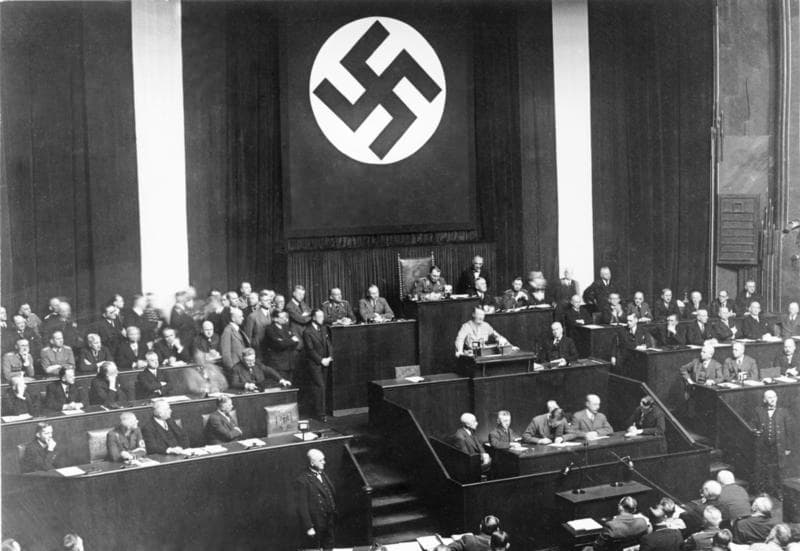
Then things moved fast. In February the Reichstag building burned. Hitler blamed the communists, and a decree suspended free speech, free assembly and due process. In March he asked parliament for an Enabling Act: his cabinet could make laws, even ones breaking the constitution, without the Reichstag. Communist deputies were banned, and SA men stood inside and outside the chamber. The Catholic Centre Party traded its votes for promises about its schools and civil servants. Only the Social Democrats voted no. Their leader, Otto Wels, told Hitler: "No Enabling Act gives you the power to destroy ideas that are eternal and indestructible." The act passed 444 to 94.
Nov 1923
Beer Hall Putsch fails; Hitler imprisoned
Dec 1924
Released after 9 months; switches to legal tactics
Jul 1932
Nazis become the largest Reichstag party
30 Jan 1933
Hitler appointed chancellor
27 Feb 1933
Reichstag fire; civil liberties suspended
23 Mar 1933
Enabling Act passes, 444–94
Aug 1934
Hindenburg dies; Hitler becomes Führer
By April Hitler held dictatorial powers, and the first concentration camp opened at Dachau for political opponents. When Hindenburg died in August 1934, Hitler merged the presidency and the chancellorship into one title: Führer. The armed coup had failed. The legal route, backed by fear and intimidation, took him about eighteen months from chancellor to dictator.
Quiz me
0/3
Recap
Hitler's 1923 armed coup failed and cost him his freedom; his 1933 legal path, through an election, a fire, a decree and a vote, cost Germany its democracy.
Surprising fact · The Enabling Act that gave Hitler the power to rule by decree passed by a parliamentary vote, 444 to 94, not by force.
Sources (3)
No source, no claim. Every fact in this lesson (19 claims) cites at least one of these.