How did one city become the turning point of the war in Europe?
German and Soviet soldiers sometimes fought on different floors of the same building, shooting at each other through holes in the floors. German troops called it the Rat War.
▶ Start the storyStalingrad became a turning point because the German army sent to take it was itself surrounded and destroyed there. The city mattered to both sides. It was a major Soviet industrial center and a key transport hub on the Volga River. It also bore Stalin's name, and Hitler wanted it for that symbol. He ordered that once it fell, its men would be killed and its women and children deported.
German bombing destroyed much of the city. The fighting became house to house, then room by room. German and Soviet soldiers sometimes held different floors of the same building and fired at each other through holes in the floors. German troops called it Rattenkrieg, the "Rat War." Historian Antony Beevor wrote that its "savage intimacy" appalled the generals, who felt they were losing control of events.
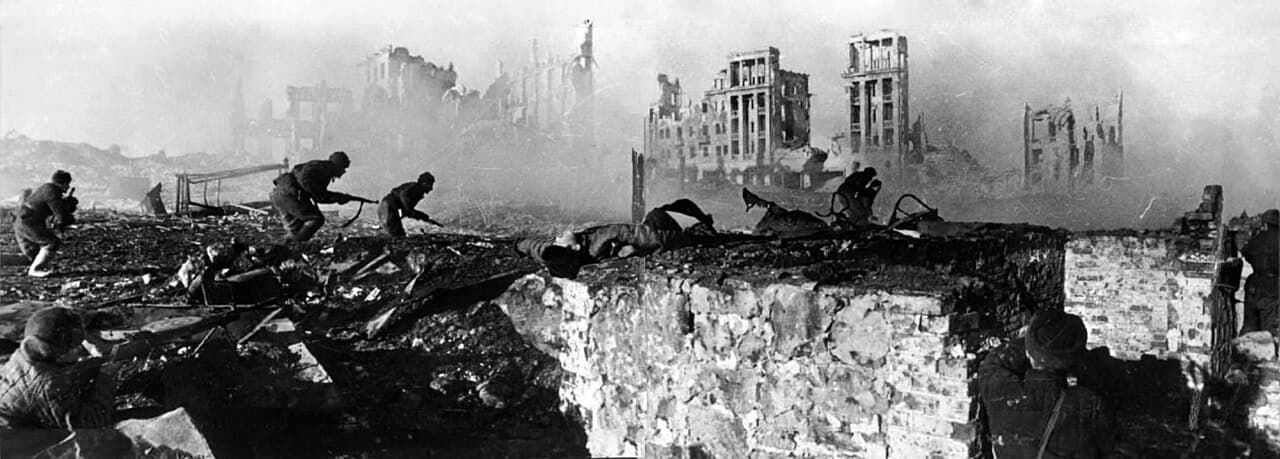
By mid-November the Germans had pushed the Soviet defenders into narrow strips along the river. Then, on 19 November, the Red Army launched Operation Uranus. It did not hit the Germans head-on. It struck the weaker Romanian armies guarding their flanks. The flanks collapsed, and the German 6th Army was surrounded. Hitler refused to let it break out. An airlift was meant to supply it, but it delivered about 105 tons a day, far below the 750 tons needed. Starving and out of ammunition, the 6th Army surrendered on 2 February 1943, the first of Hitler's field armies to do so.
23 Aug 1942
German assault begins with a massive air raid
Nov 1942
Soviet defenders pushed to the Volga's edge
19 Nov 1942
Operation Uranus encircles the 6th Army
2 Feb 1943
6th Army surrenders, the first of Hitler's armies to do so
No one knows exactly how many people died. Axis casualties, meaning killed, wounded or captured, are estimated at 800,000 to 1.5 million, and the top figure has been called an overestimate. Soviet archives list about 1.1 million Soviet casualties, and later estimates are higher. Over one million soldiers and civilians are estimated to have been killed. After Stalingrad, the initiative on the Eastern Front passed to the Soviet Union.
Quiz me
0/3
Recap
A Soviet pincer attack on weaker allied armies, not a direct assault on the Germans, was what encircled and ultimately destroyed the 6th Army.
Surprising fact · Soldiers sometimes fought from different floors of the same building, a kind of combat German troops themselves nicknamed the 'Rat War.'
Sources (1)
No source, no claim. Every fact in this lesson (16 claims) cites at least one of these.