How can a full hotel with infinite rooms still fit one more guest?
Every room is taken. A bus of infinitely many new guests just pulled up. The manager doesn't panic: he just asks everyone to move.
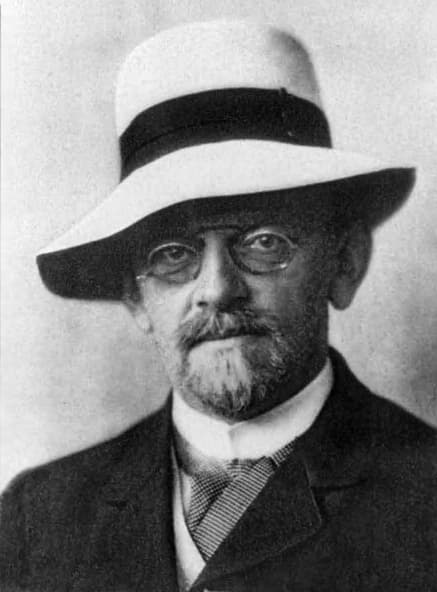
▶ Start the storyBy asking every guest to move one room up. Picture a hotel with rooms numbered 1, 2, 3 and so on with no end, every one of them occupied. When one more guest arrives, the guest in room 1 moves to room 2, the guest in room 2 to room 3, and in general everyone moves from room n to room n+1. Because there is no last room, nobody is left without one, and room 1 is now free for the newcomer. This thought experiment was introduced by the mathematician David Hilbert in a 1924-1925 lecture, and later popularized by George Gamow's 1947 book One Two Three... Infinity.
The same trick scales. If k new guests show up, every guest just moves from room n to room n + k, opening up exactly k empty rooms at the start. And if an entire infinite busload of new guests arrives, infinitely many of them, the hotel still manages: every current guest moves from room n to room 2n, instantly filling only the even-numbered rooms and leaving all the odd-numbered rooms, which are themselves infinite, empty for the newcomers. You can push it further still: infinitely many buses, each carrying infinitely many passengers, can all be seated, and there are several ways to do it. Some, like the 'prime powers' method, leave rooms such as 15 or 847 empty; others fill the hotel completely.
What makes this work, and what makes it feel so wrong at first, is that 'the odd-numbered rooms' aren't actually a smaller slice of 'all the rooms' once you're dealing with infinity. In Hilbert's Grand Hotel, the quantity of odd-numbered rooms is not smaller than the total number of rooms: mathematically, the two sets have the same cardinality, the same 'size' in the technical sense, even though one looks like exactly half of the other.
This isn't just a cute trick confined to an imaginary hotel. The same reasoning explains something genuinely surprising about ordinary numbers: the rational numbers (all the fractions) contain every whole number as a subset, and yet there are no more rational numbers than there are whole numbers, because you can pair them up one-to-one, just like Hilbert's guests moving rooms.
Quiz me
0/3
Recap
To add k guests, shift every guest from room n to room n+k; to add infinitely many guests, shift every guest from room n to room 2n and fill the freed odd rooms.
Surprising fact · The odd-numbered rooms in an infinite hotel are just as numerous as all the rooms combined, and by the same logic, the rational numbers are no more numerous than the whole numbers.
Sources (2)
No source, no claim. Every fact in this lesson (14 claims) cites at least one of these.