How can there be ice on Mercury, the planet closest to the Sun?
Mercury's equator reaches 420°C in sunlight, yet radar and the MESSENGER probe found water ice hiding in its polar craters.
▶ Start the storyBecause some places on Mercury never see the Sun. The floors of deep craters near its poles are never exposed to direct sunlight, and they stay below 102 kelvin, about −171°C, far colder than the planet's average. That makes them cold traps where ice can accumulate, even on a world whose equator ranges from −170°C at night to 420°C in sunlight.
The lack of air is what makes both extremes possible. Mercury has only a trace atmosphere, too thin to trap heat, which is also why it is only the second-hottest planet, after Venus. With no atmosphere and a steep temperature gradient between equator and poles, the poles never climb above 180 kelvin.
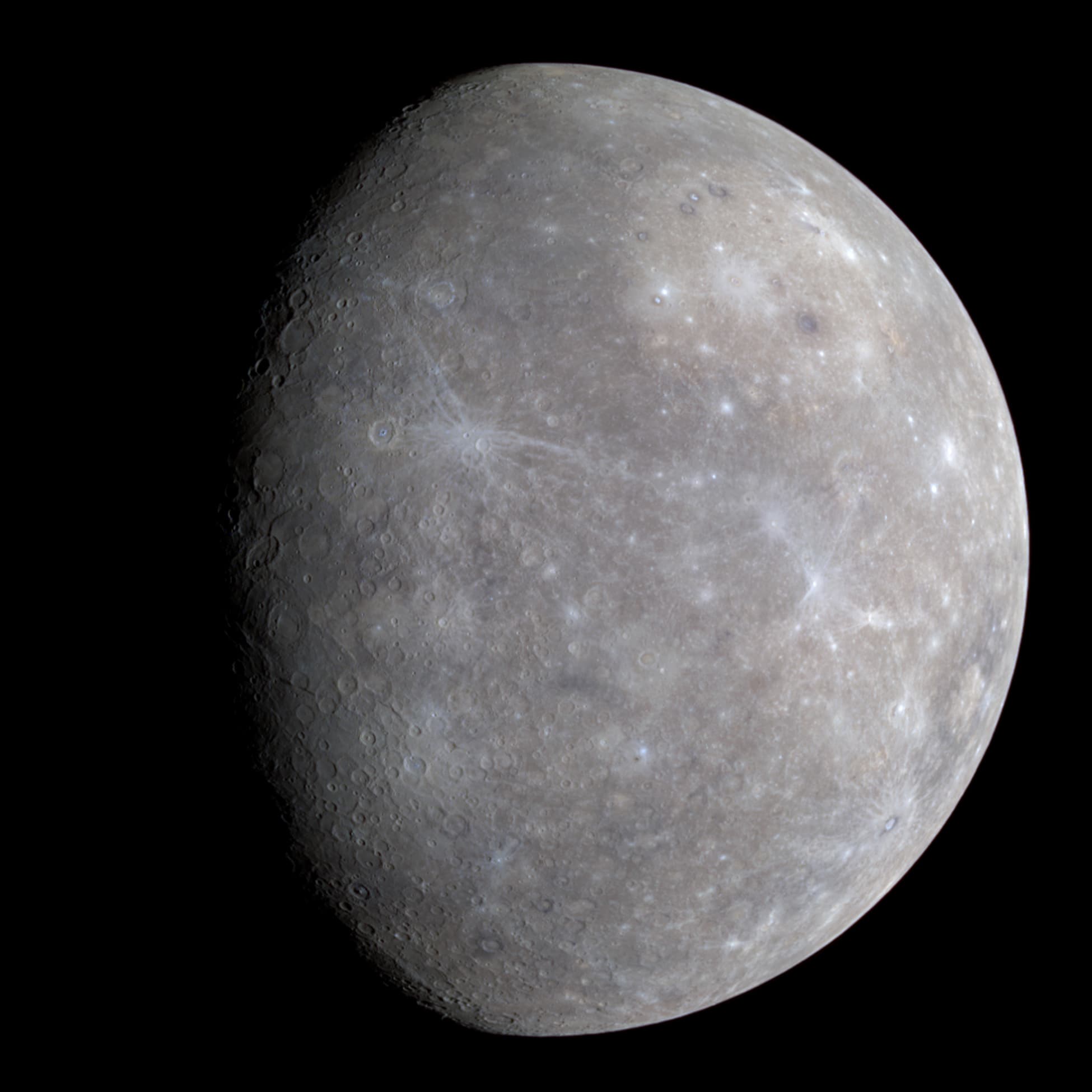
The ice was spotted before it was seen. Water ice strongly reflects radar, and in the early 1990s the Goldstone Solar System Radar and the Very Large Array found patches of high radar reflection near Mercury's poles. Ice wasn't the only possible explanation, but astronomers thought it the most likely. NASA's MESSENGER spacecraft later confirmed it with images of craters at the north pole.
There isn't much of it by planetary standards: an estimated 10^14 to 10^15 kilograms, compared with about 4×10^18 kilograms in Earth's Antarctic ice sheet and about 10^16 kilograms of water in Mars's south polar cap. It may be covered by a layer of regolith, loose surface material, that slows its sublimation.
Quiz me
0/3
Recap
No air, no heat sharing: on Mercury, permanent shadow is a freezer right next to an oven.
Surprising fact · Mercury's polar ice, an estimated 10^14 to 10^15 kg, is tiny next to Earth's Antarctic ice sheet, about 4×10^18 kg.
Sources (1)
No source, no claim. Every fact in this lesson (13 claims) cites at least one of these.