How did Roberto Carlos bend a free kick that looked like it was going out?
A ball boy ducked, the goalkeeper froze, and physicists needed 13 years to explain the spiral.
▶ Start the storyRoberto Carlos's free kick bent so much because he hit it hard, with heavy side-spin, from very far out, and a spinning ball that slows down curves more and more. On 3 June 1997, against France, he struck the ball 40 yards from goal with the outside of his left foot. It swung so wide that a ball boy standing ten yards to the right ducked, then curled back on target while the goalkeeper, Fabien Barthez, stood rooted to the spot.
The force behind it is the Magnus effect. A spinning ball drags a thin layer of air around with it, speeding up the airflow on one side and slowing it on the other. Faster flow means lower pressure, so the ball is pushed sideways, towards the side its front is turning. You can also see it as action and reaction: the ball flings the air behind it one way, so the air pushes the ball the other way.
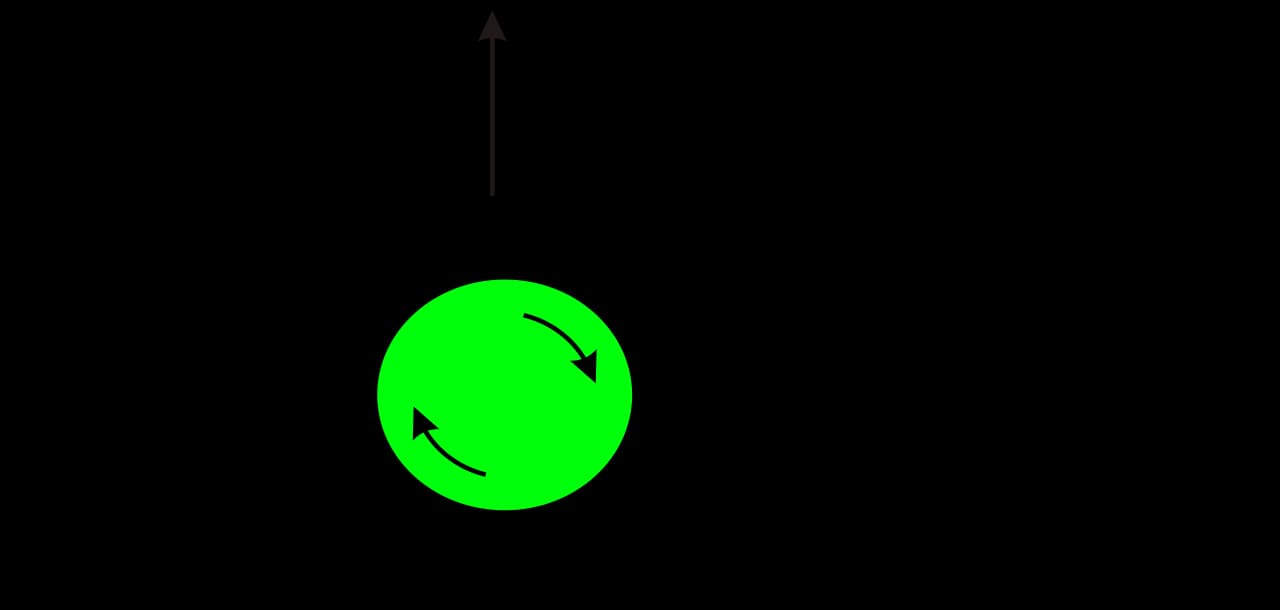
What made this kick special is what happened late in its flight. In 2010 a team of French physicists showed that when a ball keeps spinning while drag slows it down, its path is not a simple arc but a spiral that tightens as the ball loses speed. Over a short distance you barely see it. Over 40 yards, struck very hard, the bend sharpens just as the ball nears the goal, which is why it looked as if it changed its mind in mid-air.
Quiz me
0/3
Recap
Spin pushes, drag slows, and the slower spinning ball curls harder.
Surprising fact · Isaac Newton explained the effect in 1672 after watching tennis players, nearly two centuries before Magnus demonstrated it.
Connects to
- ⛳ Why do golf balls have dimples?
- ⚾ How does a curveball curve?
- Bernoullis principle
- Knuckleball
- Rotor ship
Sources (5)
No source, no claim. Every fact in this lesson (25 claims) cites at least one of these.