Does your tongue really have a sweet zone and a bitter zone?
The tongue map from school is wrong: every part of your tongue tastes everything. It began with a misread graph.
▶ Start the storyNo. The famous tongue map, with sweet at the tip, bitter at the back and salty and sour along the sides, is a myth. Every taste can be detected by every region of the tongue. Some parts are slightly more sensitive to a given taste, meaning they notice it at a lower concentration, but once you taste it, it feels just as strong anywhere.
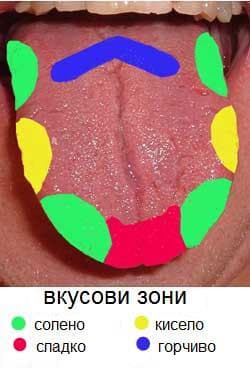
The myth began with a graph. In 1901 a German scientist, David Hänig, measured how sensitive different parts of the tongue were to each taste and found very small differences. In 1942 the Harvard psychologist Edwin Boring translated the work and redrew the graphs. Later authors misread the redrawn curves: where a line dipped, they assumed there was no taste at all, and where it peaked, they assumed that was the only place it lived. A tiny difference became a map.
The map stuck. Into the late 1990s, biology students were handed taste strips and told where each flavour should land on a partner's tongue, even though in 1974 the researcher Virginia Collings had already confirmed that all tastes exist on all parts of the tongue.
You can test it yourself: a drop of something sweet on the back of your tongue still tastes sweet. Your 2,000 to 5,000 taste buds are spread around your mouth, and each one holds 50 to 100 receptor cells.
Quiz me
0/3
Recap
Parts of the tongue may notice a taste a little sooner, but every part tastes everything just as strongly.
Surprising fact · Students were still doing tongue-map experiments in the late 1990s, although a 1974 study had confirmed all tastes exist on all parts of the tongue.
Sources (3)
No source, no claim. Every fact in this lesson (15 claims) cites at least one of these.