Was Baghdad's House of Wisdom really a university, or a myth?
Legend says Baghdad's House of Wisdom held open scholarly debates like a medieval university. One historian says the name might just mean 'storehouse'.
▶ Start the storyIt depends who you ask. The House of Wisdom, also called the Grand Library of Baghdad, was certainly a major Abbasid-era institution: it was founded either as a library for caliph Harun al-Rashid's collections in the late 8th century or as a private collection of caliph al-Mansur, and under caliph al-Ma'mun it became a public academy and library. But the popular image of it as a proto-university, with specialised departments and organised scholarly debates, has been challenged by some historians, who argue that picture was shaped in the 19th and early 20th centuries by Orientalist scholars through translation errors and projecting later ideas backward. One Yale Arabist, Dimitri Gutas, goes further: he thinks 'House of Wisdom' may simply be a mistranslation of Khizanat al-Hikma, a phrase that just means a storehouse.
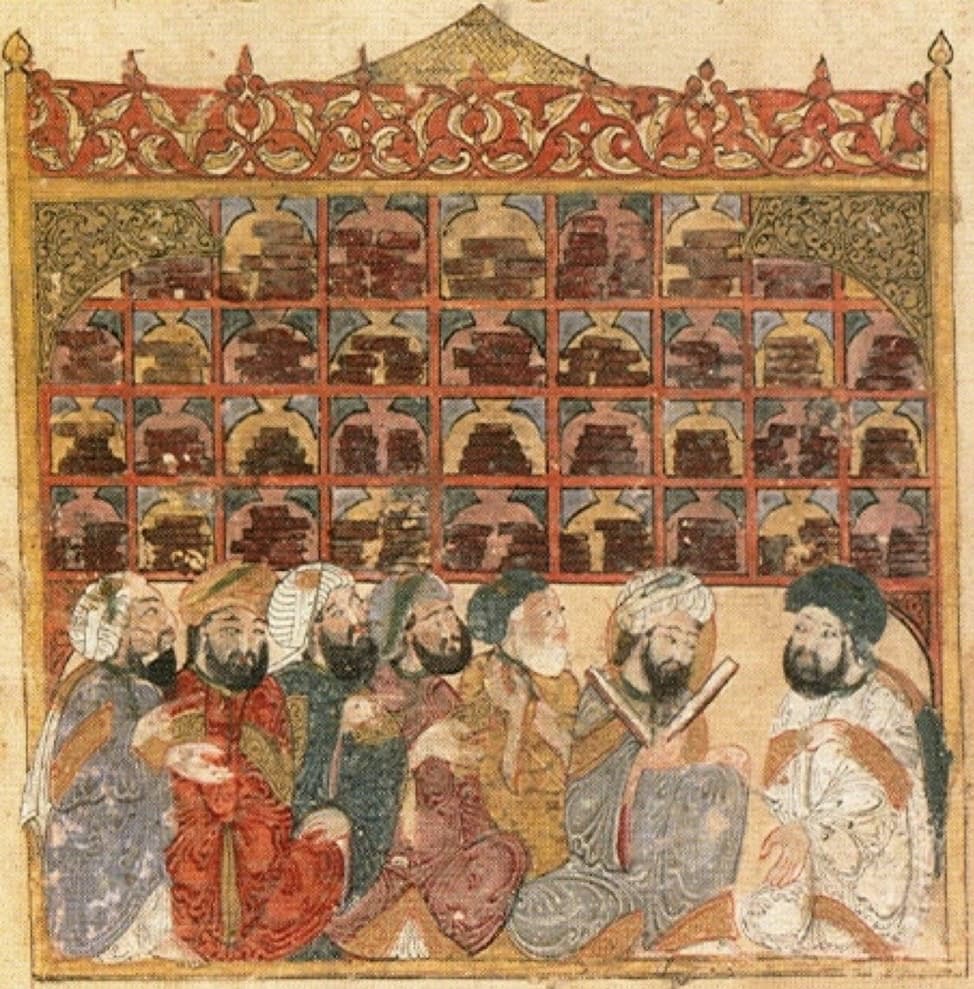
What's not in doubt is that Baghdad became a magnet for translators and original thinkers. The House of Wisdom existed within the larger Translation Movement that rendered Greek and Syriac works into Arabic, though it probably was not the only center of that work, since Cairo and Damascus had translation efforts even earlier. Scholars linked to it include Muhammad ibn Musa al-Khwarizmi, the Persian polymath who founded algebra and gave his name to the word 'algorithm', and Hunayn ibn Ishaq, a Christian scholar placed in charge of the House of Wisdom who translated more than 116 works in his lifetime. Al-Ma'mun also organized research into the Earth's circumference and commissioned one of the most detailed world maps of its time.
The ending is dramatic either way. On 13 February 1258, the Mongols entered Baghdad and spent a full week pillaging and destroying it, and the House of Wisdom was destroyed along with the city's other libraries. The Tigris was said to have run black with ink from all the books thrown into it, and a 16th-century chronicle went further, claiming the books formed a bridge that could carry a man on horseback; historian Michal Biran calls that bridge a literary trope meant to magnify Mongol barbarity. At least one scholar, Nasir al-Din al-Tusi, is said to have rescued around 400,000 manuscripts before the siege, carrying them off to Maragheh.
Quiz me
0/3
Recap
A real translation movement and remarkable scholars are well documented, even though the House of Wisdom's popular image as a formal university is contested.
Surprising fact · A Yale Arabist argues the name may be a mistranslation meaning simply 'storehouse', and a historian treats the tale of a bridge made of thrown books as a literary trope.
Sources (1)
No source, no claim. Every fact in this lesson (15 claims) cites at least one of these.