Were Romulus and Remus really raised by a wolf?
Rome's own founding story stars a she-wolf and two abandoned babies. Even its most famous statue of her turned out to hide a surprise.
▶ Start the storyNot really, at least not the way the legend tells it. Roman tradition says King Amulius had newborn twins Romulus and Remus left by the river Tiber to die. They survived, and a she-wolf found and nursed them in a cave. A shepherd named Faustulus then raised the boys as his own.
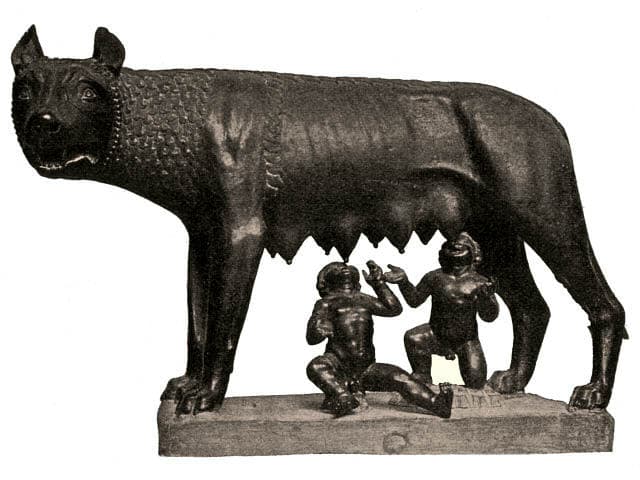
That's the official story, repeated for over two thousand years. But historians find little evidence that Romulus or Remus ever existed. Archaeology tells a slower, less dramatic tale. On the Palatine Hill, the remains of huts date to the 9th or 8th century BC. By the late 8th century BC, the hilltop villages had merged into one community. They were probably copying a Greek fashion: city-states.
So where does 753 BC, the famous founding year, come from? Roman historians themselves disagreed, placing the founding anywhere between 758 and 728 BC. The date that stuck came from the scholar Varro and his friend Atticus, centuries later, pieced together from scraps of old records. Where historians can check it today, around 340 BC, their timeline is already about four years off. Most historians today treat the single-founder story, and its exact date, as fiction layered onto a much slower process.
Even the bronze she-wolf in Rome's Capitoline Museums, the most famous image of the legend, hid a secret. For centuries, people assumed she was Etruscan, cast around the 5th century BC, with the twin babies added underneath only in the 1400s. Then, in the 21st century, scientists ran radiocarbon and thermoluminescence tests. They suggest the wolf may have been cast between 1021 and 1153 AD, some 1,800 years after the legend's date. Many experts still defend an ancient Etruscan origin, so the wolf's age is an open question.
Quiz me
0/3
Recap
753 BC is a scholar's calculation made centuries later, not a date anyone recorded at the time; the real Rome grew from huts on a hill over generations.
Surprising fact · Scientific dating suggests the famous Capitoline Wolf may be medieval, cast some eighteen centuries after Rome's legendary founding; the question is still debated.
Sources (4)
No source, no claim. Every fact in this lesson (17 claims) cites at least one of these.