What did the Buddha teach in his first sermon?
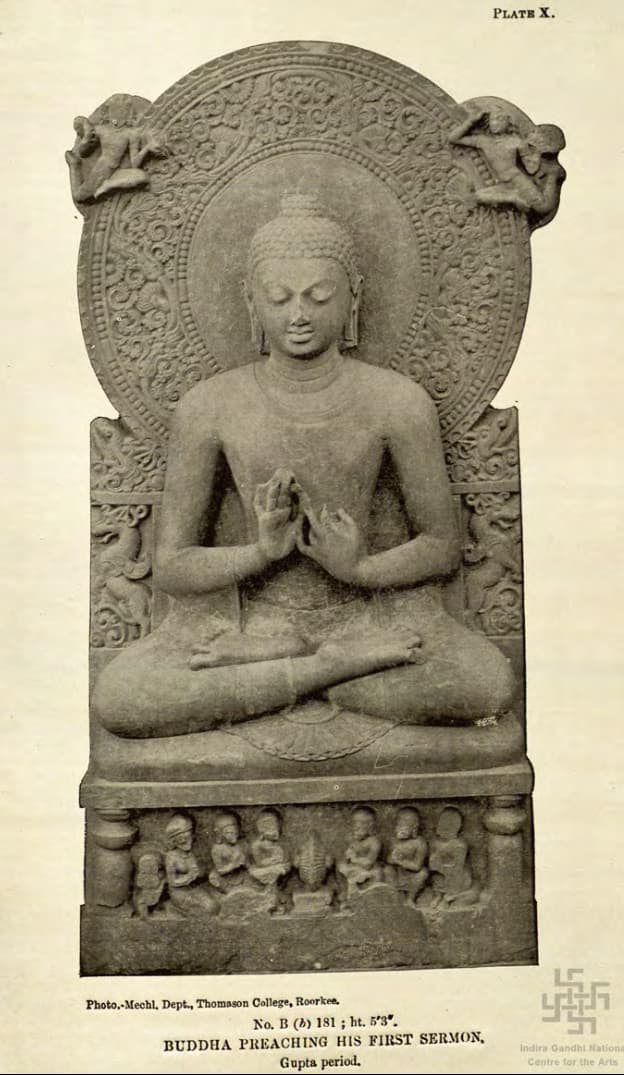
Buddhist tradition says the Buddha's first sermon was to five old friends who had walked out on him. It fits in four sentences.
▶ Start the storyAccording to Buddhist tradition, the Buddha's first sermon set out the Four Noble Truths. First, dukkha: life in a world where everything passes cannot give lasting satisfaction. Second, its origin: craving, clinging and aversion towards those passing things. Third, its cessation: letting go of craving can "blow out" that unease, which is what nirvana means. Fourth, the path: the Noble Eightfold Path that leads there.
The word dukkha is usually translated "suffering", but some teachers think that misleads. It covers pleasant things too, simply because they don't last: a wonderful holiday is dukkha in the sense that it ends.
Step 1: Dukkha
Transient life cannot give lasting satisfaction
Step 2: Samudaya
Its origin: craving, clinging and aversion
Step 3: Nirodha
Its cessation: letting go "blows out" the unease (nirvana)
Step 4: Marga
The path: the Noble Eightfold Path
The setting has a very human edge. Buddhists consider a text called the Dhammacakkappavattana Sutta, "Setting the Wheel of Dhamma in Motion", to record this sermon, given in the Deer Park at Sarnath, near Varanasi. On the road there, the first person the Buddha told about his awakening, a seeker named Upaka, was not convinced and went his own way. The audience at Sarnath was five ascetics, his former companions. The sermon also taught the Middle Way, between sensual indulgence and harsh self-denial.
Historians add caution. Many scholars think the text was labelled the "first sermon" only later. And the popular idea that the four truths copy a doctor's diagnosis, proposed in 1882, remains a hypothesis that some specialists consider unproven.
Quiz me
0/3
Recap
Unease, its cause, its end, the path: Buddhist tradition places these four truths in the Deer Park at Sarnath.
Surprising fact · "Suffering" may be a misleading translation: even pleasant experiences count as dukkha, because they end.
Sources (2)
No source, no claim. Every fact in this lesson (20 claims) cites at least one of these.