What happens when matter meets its mirror twin, antimatter?
An equation Paul Dirac wrote down to describe the electron also, almost by accident, predicted a whole mirror world of matter.
▶ Start the storyEvery particle of matter has a mirror-image twin: the same mass, but opposite electric charge and opposite quantum numbers. An electron's twin is the positron. When a particle meets its twin, they don't just bounce apart, they annihilate each other completely, their whole mass converting into energy, usually as a burst of gamma rays.
This mirror world was found first on paper, not in a lab. In 1928, physicist Paul Dirac wrote an equation to describe the electron using quantum mechanics and special relativity together. The equation worked, but it stubbornly allowed for a second, puzzling solution: electrons with negative energy. After other physicists argued his first guess (that this solution described the proton) couldn't be right, Dirac published a bolder claim in 1931: there must be an unseen particle with the electron's mass but the opposite charge, one that would destroy itself and an electron on contact.
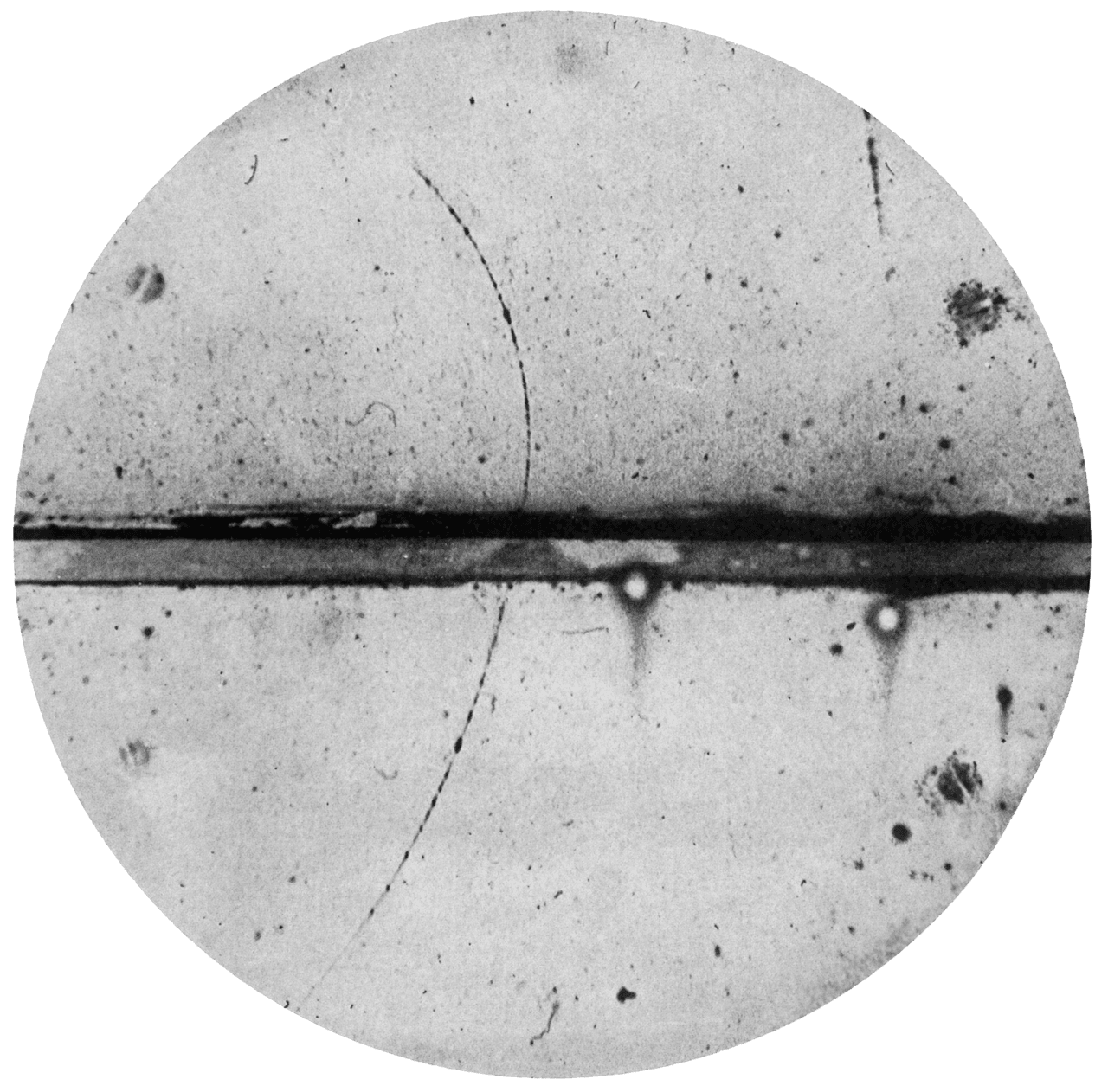
The proof came fast. In 1932, Carl Anderson, studying cosmic rays in a cloud chamber, spotted a track left by a particle with an electron's mass but a positive charge, exactly Dirac's predicted twin. He confirmed it by firing gamma rays into matter and watching electron-positron pairs pop into existence. Anderson shared a Nobel Prize for the discovery, and Dirac's equation was vindicated.
Annihilation isn't just theoretical anymore, it happens inside you right now. Potassium-40 in your body naturally decays and produces positrons that collide with ordinary electrons, releasing paired bursts of light thousands of times a day. Hospitals harness exactly this process deliberately: PET scanners detect the light from positron annihilation to build 3D images of what's happening inside a patient's body.
Quiz me
0/3
Recap
Matter and antimatter are mirror twins that destroy each other into pure energy on contact, and nobody yet knows why the universe ended up almost entirely matter.
Surprising fact · Potassium-40 decay naturally produces about 4,000 positrons a day inside the human body, annihilating with electrons in the same process a PET scanner uses to image patients.
Connects to
- ⚖️ Why didn't matter and antimatter wipe each other out at the start?
- ☄️ Why are particles from deep space passing through your head right now?
- 💥 Why was the Big Bang not really a bang?
- ⏳ How can radioactive atoms work as a clock if each one decays at random?
- ☀️ How does the Sun shine if its core is too cold for fusion?
Sources (4)
No source, no claim. Every fact in this lesson (14 claims) cites at least one of these.