Where does the word "OK" come from?
Possibly the most used word on the planet started as a deliberately misspelled joke in 1830s Boston newspapers.
▶ Start the storyOK most likely comes from a joke: it is short for 'oll korrect', a deliberately bad spelling of 'all correct' that circulated in Boston newspapers in the late 1830s. Most modern dictionaries accept this origin, first worked out by the linguist Allen Walker Read in the 1960s.
The joke makes sense in context. In 1838, Boston writers had a craze for abbreviations, like NG for 'no go' or GT for 'gone to Texas', and for comic misspellings. One of OK's cousins was OW, 'oll wright'. Read tracked down the earliest printed OK in the Boston Morning Post of 23 March 1839, where the writer helpfully explained it: 'o.k.—all correct'.
1838
Boston abbreviation craze: NG, GT, OW…
23 March 1839
First known OK in print, Boston Morning Post
1840
Presidential campaign: 'Old Kinderhook'
1918
Woodrow Wilson signs memos 'Okeh'
1960s
Allen Walker Read documents the origin
Most of those abbreviations vanished. OK survived thanks to politics. In the 1840 presidential election, supporters of President Martin Van Buren, nicknamed 'Old Kinderhook' after his hometown, claimed OK stood for him, while his opponents mocked it as the bad spelling of his predecessor, Andrew Jackson. The quarrel spread the word across the country.
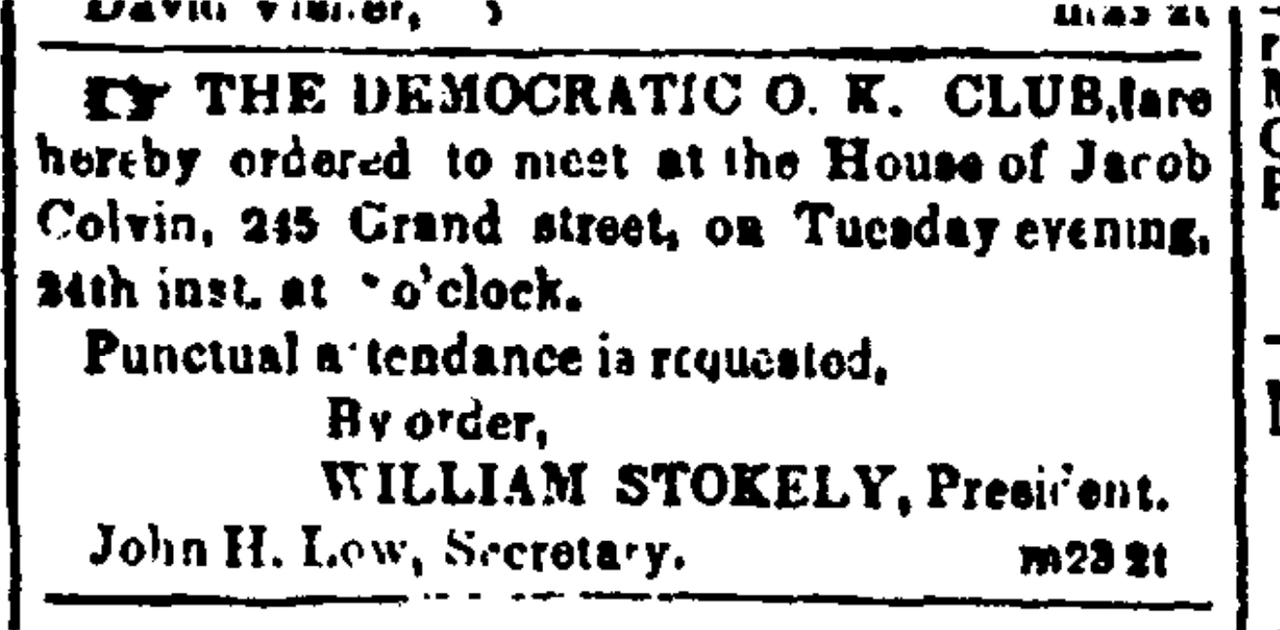
Other origin stories exist. American dictionaries long favoured the Choctaw word 'okeh', meaning 'it is so', and many popular tales, such as a French 'Au quai !' shouted on Louisiana docks, have no documentary support. Today OK may be the most spoken or written word on Earth.
Quiz me
0/3
Recap
OK = 'oll korrect', a joke from 1839 that politics turned into a word for everyone.
Surprising fact · The popular story that OK comes from the French 'Au quai !' has no documentary support.
Connects to
- 🦞 Why does a crayfish have nothing to do with fish?
- 🔤 Why is NASA an acronym but FBI isn't?
- 🍵 Why does nearly every word for tea sound like "tea" or "cha"?
- 1840 united states presidential election
- Dialog box
Sources (2)
No source, no claim. Every fact in this lesson (16 claims) cites at least one of these.