Why isn't 1 a prime number?
As late as 1956, published tables of primes still started with 1. Then mathematicians quietly kicked it out of the club.
▶ Start the story1 isn't prime because mathematicians decided it shouldn't be, and they had a very good reason. A prime is a whole number greater than 1 that can't be written as a product of two smaller whole numbers, and the phrase "greater than 1" is there on purpose: 1 is specifically excluded. Another way to say it: a prime has exactly two divisors, 1 and itself. The number 1 has only one divisor, itself, so it doesn't qualify.
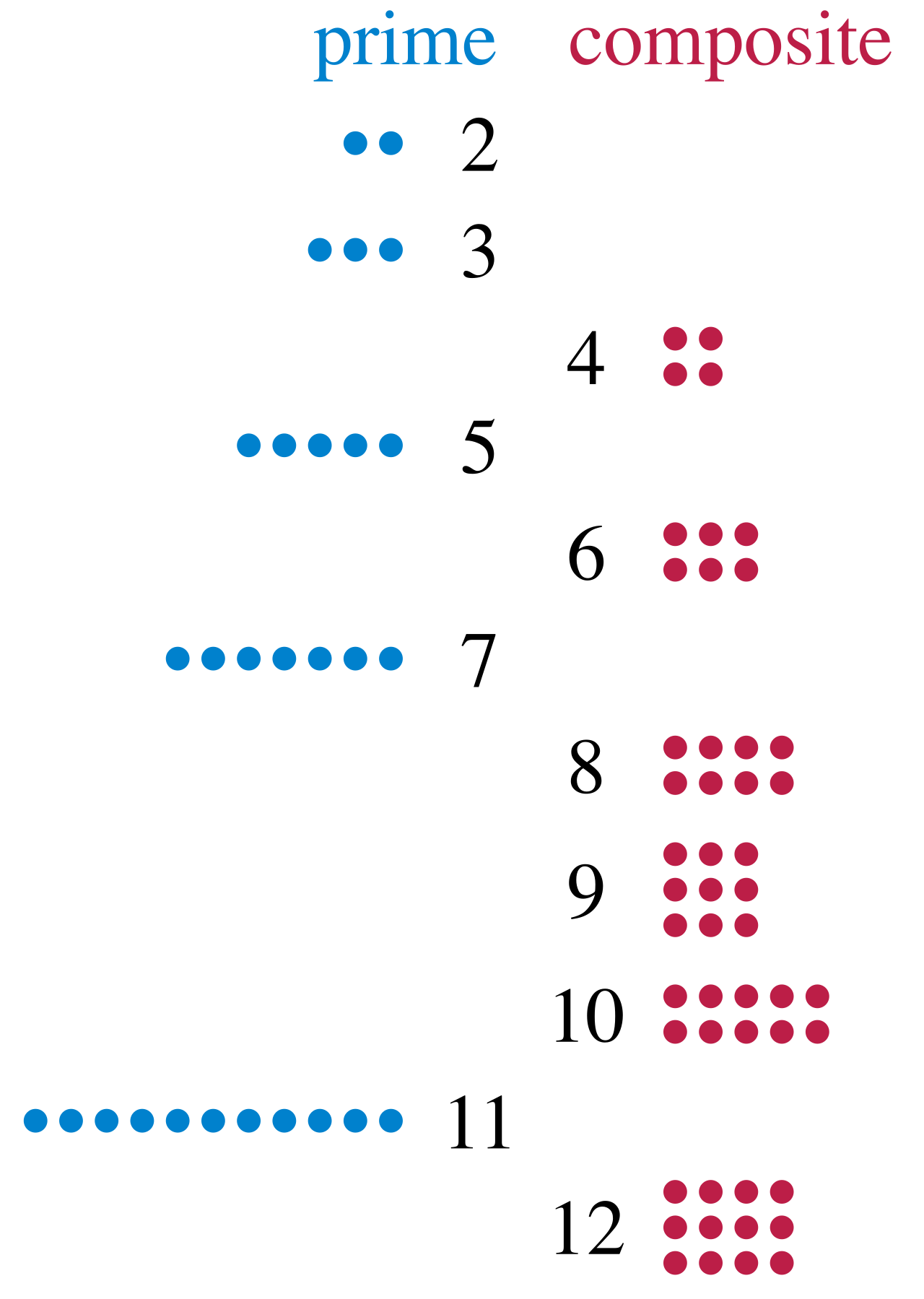
The real reason is what primes are for. Every whole number above 1 can be written as a product of primes in exactly one way, apart from the order: 12 is 2 × 2 × 3 and nothing else. Primes are the building blocks of all the other numbers. If 1 counted as a building block, that uniqueness would collapse, because you could tack on as many copies of 1 as you like: 2 × 3, 1 × 2 × 3, 1 × 1 × 2 × 3, and so on forever.
This wasn't always obvious. Christian Goldbach listed 1 as a prime in his letters to Leonhard Euler in the 18th century, and printed tables of primes that began with 1 were still being published as recently as 1956. By then, most mathematicians had agreed to give 1 its own special category: a "unit".
Quiz me
0/3
Recap
Primes are the building blocks of numbers, and a block you can add endlessly without changing anything isn't a building block.
Surprising fact · Goldbach listed 1 as prime to Euler, and Lehmer's 1914 table of primes below ten million began with 1.
Sources (1)
No source, no claim. Every fact in this lesson (16 claims) cites at least one of these.