How can printers make so many colors from just four inks?
An 18th-century engraver found how to fake a full-color painting with three plates of ink. Printers still use his trick today, plus one extra color.
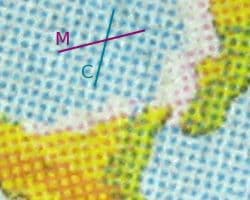
▶ Start the storyBecause they don't mix new inks at all: they print with four inks, cyan, magenta, yellow and black, laid down as tiny dots, and let your eye do the rest. Up close, those dots don't blend into new colored ink at all; your eye does the mixing, because varying how big and how closely spaced the dots are creates the illusion of countless in-between shades. Without that trick, called halftoning, those four inks could only ever produce eight flat colors total.
The idea of faking a full-color picture from a handful of inks is more than 300 years old. In 1710, a Frankfurt-born engraver named Jacob Christoph Le Blon made his first color prints using just three copper plates — one inked yellow, one red, one blue — pressed onto the same sheet of paper in sequence. He received a royal patent for the process in 1719 and opened a business selling color reproductions of famous paintings, but it collapsed by 1725. That same year he published a book, Coloritto, insisting that any color at all, mixed with black, could be built from just those three.
Modern CMYK printing is his idea with a practical upgrade: a fourth, black "key" plate. Mixing full cyan, magenta and yellow ink does make a black, but a muddy, imperfect one, so a separate black ink gives sharper text and outlines, uses less ink, and dries faster. It's also why the model is called subtractive rather than additive like a screen: ink only removes light from white paper, instead of a screen's pixels adding colored light together to make white.
Quiz me
0/3
Recap
Printers don't mix new colors of ink — they print tiny dots of just four colors and let your eye do the blending.
Surprising fact · The idea traces back to Jacob Christoph Le Blon, who made his first three-color prints in 1710 from separate copper plates, even though his printing and tapestry businesses both struggled or failed.
Sources (2)
No source, no claim. Every fact in this lesson (20 claims) cites at least one of these.