Why are physicists so sure no perpetual motion machine will ever work?
The US patent office demands a working model for one kind of invention only: perpetual motion machines. Physicists already know how every design must end.
▶ Start the storyBecause such a machine would have to break the laws of thermodynamics, which apply to systems of any size, and those laws rest on something very deep. A result proven in 1915, Noether's theorem, shows that conservation of energy follows from the laws of physics not changing over time, and telescope measurements of the distant past show physics has stayed substantially the same for billions of years. A perpetual motion machine would need the foundations of physics themselves to change.
The dream is old. In the 12th century, Bhaskara described a wheel with weights that sit farther from the center on one side and closer on the other. Weights farther out apply more torque, so it seemed the wheel should turn forever. It doesn't, because the side with the farther weights has fewer of them at that moment, and the torques balance.
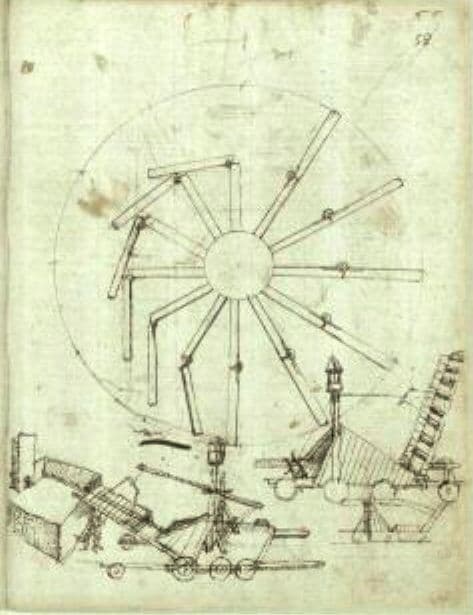
Physicists sort the failures into kinds. A machine of the first kind makes work from nothing, breaking the first law, conservation of energy. One of the second kind turns heat from a single reservoir into work, which keeps energy balanced but breaks the second law. One of the third kind tries to remove friction completely, but dissipation can never be fully eliminated.
The confidence runs so deep that, when Gabriel Lippmann proposed the 'Brownian ratchet' in 1900, scientists didn't think it could work even though nobody explained why until Marian Smoluchowski did in 1912. And so many inoperable designs were proposed that the US Patent and Trademark Office refuses to patent a perpetual motion machine without a working model, something it doesn't ordinarily ask of other devices.
Quiz me
0/3
Recap
Every perpetual motion design either tries to create energy from nothing, turn heat entirely into work with none wasted, or eliminate friction completely, and all three are forbidden by the laws of thermodynamics.
Surprising fact · It took physicists twelve years, from 1900 to 1912, to pin down exactly why the clever 'Brownian ratchet' thought experiment couldn't actually produce free energy.
Sources (1)
No source, no claim. Every fact in this lesson (13 claims) cites at least one of these.