Why do our cells stop dividing as we get older?
For decades, scientists believed a dish of chicken heart cells had lived for 34 years. Then a young researcher noticed his cells were counting.
▶ Start the storyMost of your cells stop dividing after a limited number of rounds because every division trims a little off the ends of their chromosomes. Those ends, called telomeres, are repetitive stretches of DNA that act as buffers for the genes behind them, a bit like the plastic tips on shoelaces. The copying machinery can't quite reach the very end, so a small piece is lost each time. Once telomeres get critically short, the cell enters senescence: it stays alive but never divides again.
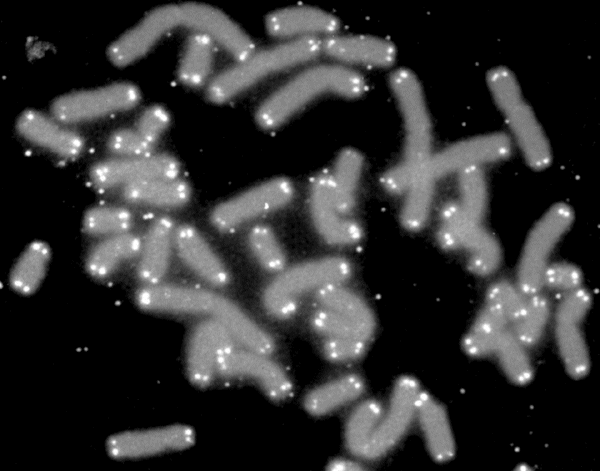
That limit was found by accident. Before then, the celebrated surgeon Alexis Carrel claimed he had kept chicken heart cells growing for 34 years, longer than any chicken lives, and scientists believed normal cells were immortal. In 1961 Leonard Hayflick, at the Wistar Institute in Philadelphia, noticed his human cells always gave up after 40 to 60 divisions. Nobody ever repeated Carrel's result; fresh cells may have been slipped in with the daily feed.
Senescence isn't a design flaw. It is thought to guard against cancer: most cancer cells escape it by switching on telomerase, an enzyme that rebuilds telomeres. But when the immune system can't clear senescent cells fast enough, they accumulate and release inflammatory signals, and they contribute to frailty and age-related diseases. In 2011, removing them from mice delayed age-related disorders.
Telomeres aren't the whole story of ageing, though. Cells in the body divide far fewer times than in a dish, and DNA damage can trigger senescence too.
Quiz me
0/3
Recap
Each division trims the telomeres; too short, and the cell retires but keeps sending signals.
Surprising fact · Hayflick proved cells count their divisions by mixing old male cells with young female ones and watching only the female cells keep going.
Sources (4)
No source, no claim. Every fact in this lesson (32 claims) cites at least one of these.