Why did breaking up America's oil monopoly create two new giants?
In 1911, the US Supreme Court broke up Standard Oil, then the largest corporation in the United States. Its pieces were so big that two of its lineages are now ExxonMobil and Chevron.
▶ Start the storyBecause the pieces were giants already, in a market that was booming. When the US Supreme Court ruled Standard Oil an illegal monopoly in 1911, it split the trust into separate companies, 33 by one count and 39 by another, but splitting it did not make the business small. The biggest pieces, Standard Oil of New Jersey and Standard Oil of New York, were huge on their own: even after losing companies worth 57% of its value, Jersey Standard was still the second-largest corporation in the United States. Meanwhile, demand for petroleum products was growing faster than Standard had been able to expand.
A monopoly is a market with a single supplier and no real competition, which lets it charge prices well above its costs. Standard Oil came close: it ran a near monopoly of American oil from 1899 until 1911 and was the largest corporation in the country. The case against it came about partly because of the journalist Ida Tarbell, author of The History of the Standard Oil Company. Yet its grip was already slipping, since its share of US refining capacity had fallen from 90% in 1880 to 60–65% by 1911 as competitors grew.
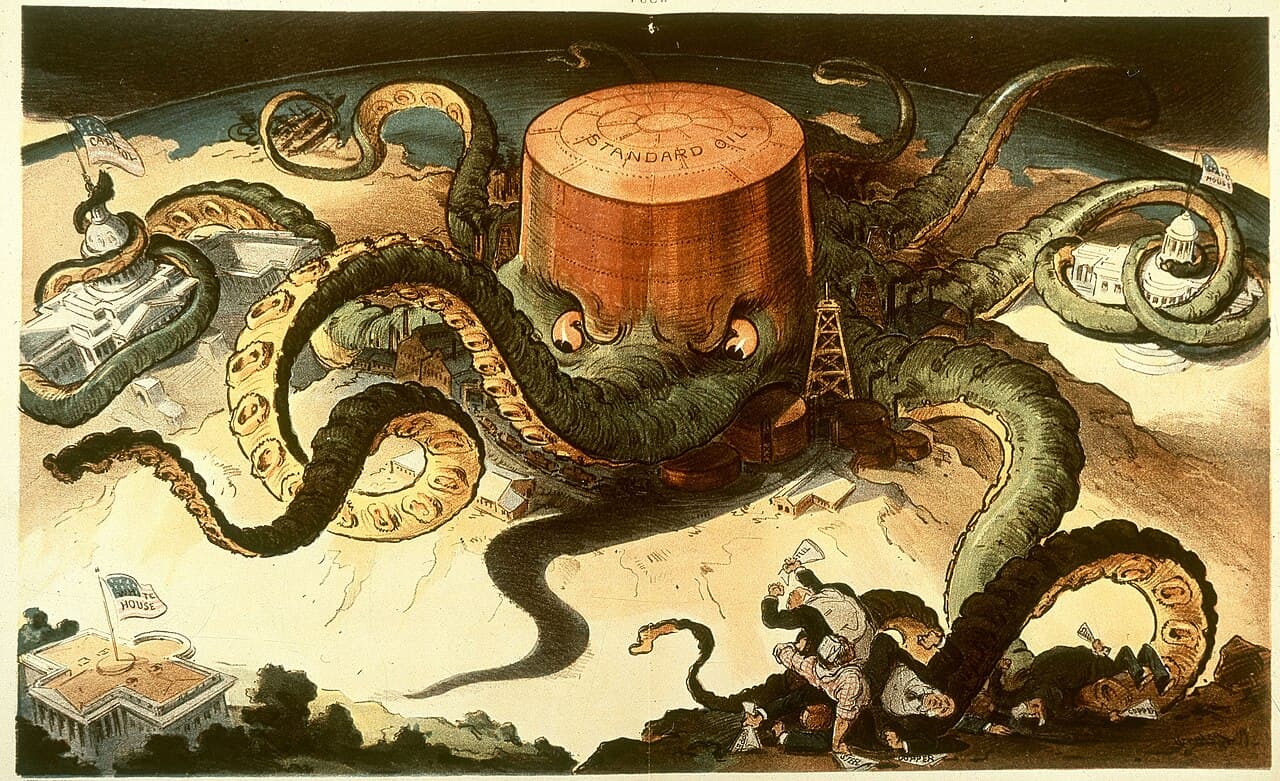
After the breakup, the pieces kept growing. Jersey Standard, led by Walter C. Teagle, became the largest oil producer in the world; it was renamed Exxon in 1973, then ExxonMobil in 1999 after merging with Standard Oil of New York, which had become Mobil. Standard Oil of California became Chevron. The most surprising winner was John D. Rockefeller: he owned a quarter of the shares of the new companies, their values mostly doubled, and he came out of the breakup as the richest man in the world.
Quiz me
0/3
Recap
Breaking up Standard Oil split ownership, not size: its biggest pieces, Jersey Standard and Standard Oil of California, grew into ExxonMobil and Chevron in a booming oil market.
Surprising fact · John D. Rockefeller came out of Standard Oil's breakup as the richest man in the world, because the shares of the new companies mostly doubled in value.
Sources (2)
No source, no claim. Every fact in this lesson (22 claims) cites at least one of these.