Why did a generation of painters move to one small forest village?
They wanted to paint the forest itself, not myths or battles in front of it. Their small village ended up giving its name to a whole school of painting.
▶ Start the storyA generation of French painters gathered in a single small village, Barbizon, at the edge of the Forest of Fontainebleau, because they wanted to paint nature itself as the subject of a picture, not just as scenery behind a dramatic event. The spark came from abroad: when the Paris Salon of 1824 showed rural landscapes by the English painter John Constable, it pushed younger French artists to abandon rigid formal rules and draw directly from nature instead.
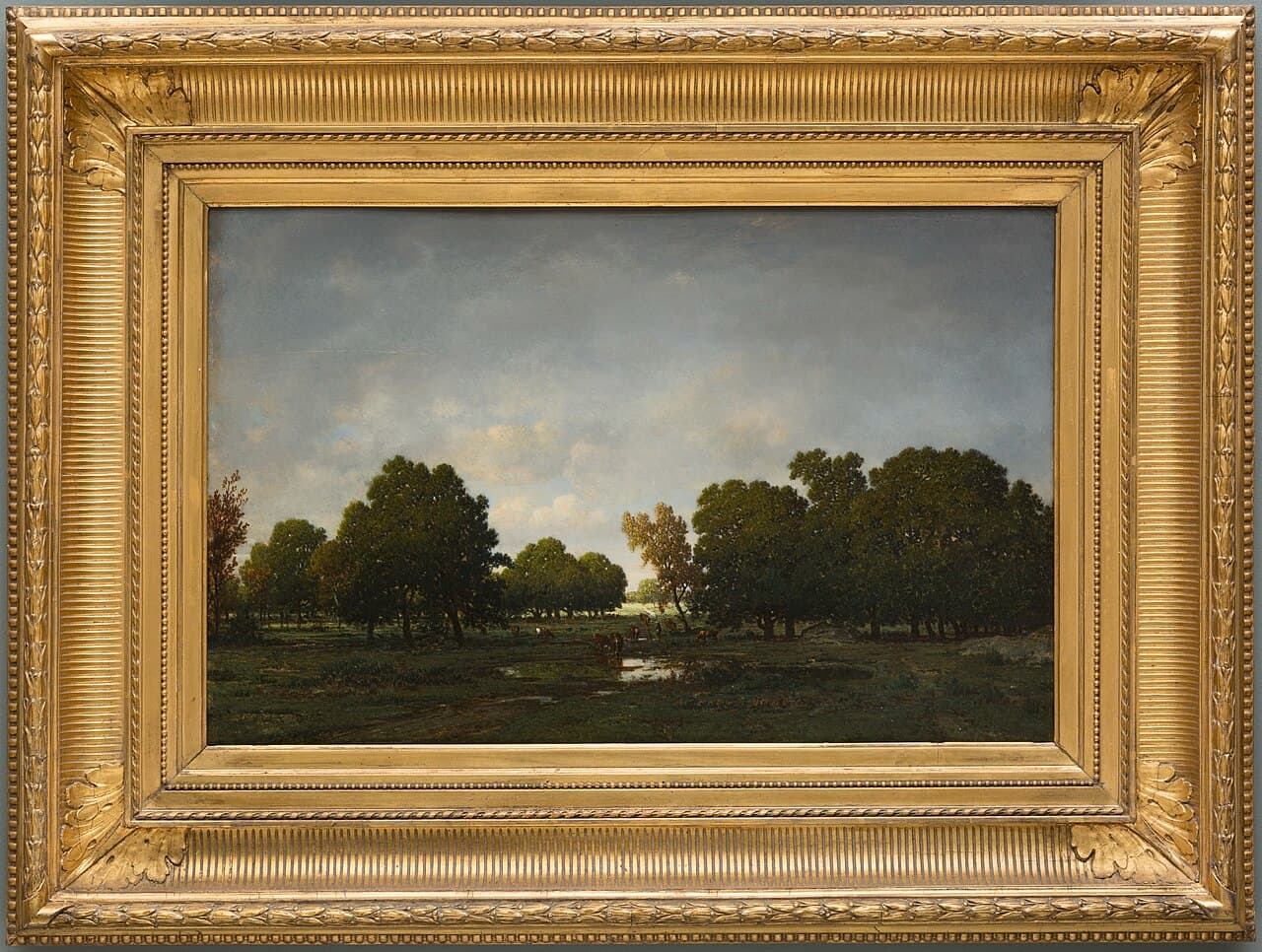
Jean-Baptiste-Camille Corot got there early, painting in the forest as early as 1822 and coming to Barbizon in 1829, 1830 and 1831, where he met painters of the school, including Théodore Rousseau and Jean-François Millet. During the political upheaval of the Revolutions of 1848, more artists gathered there to work on the same idea: ordinary French landscape, painted for its own sake. Millet pushed the idea further, putting ordinary peasants at work, rather than the forest itself, at the center of paintings like The Gleaners, which shifted attention from the prosperous to people at the bottom of the social ladder.
The Barbizon painters still worked the old way in one key respect: they sketched outdoors but finished their paintings back in the studio. It was the next generation, including Claude Monet, Pierre-Auguste Renoir and Alfred Sisley, who visited the same forest in the late 1860s, and in the 1870s developed Impressionism and the practice of painting outdoors, en plein air. Vincent van Gogh later copied Millet's paintings more than those of any other artist, 21 times over. Rousseau died at Barbizon in 1867, and Millet in 1875, in the village that gave the whole school its name.
Quiz me
0/3
Recap
A whole art movement is named after the one small forest village where its painters chose to live and work.
Surprising fact · Vincent van Gogh copied Jean-François Millet's paintings 21 times, more than any other artist he studied.
Sources (1)
No source, no claim. Every fact in this lesson (12 claims) cites at least one of these.