How do your two eyes let you see the world in 3D?
In 1838, a pair of angled mirrors made two flat drawings look like one solid object, a year before practical photography arrived.
▶ Start the storyYour two eyes look at the world from slightly different positions, so each sends the brain a slightly different picture. The brain uses that difference in perspective to judge depth, a skill called stereopsis, and to recognize shapes, see through camouflage and work out where things are. Around 93% of adults under 60 have functional stereopsis; about 7% are stereoblind and lack it. Two eyes also help in another way: their signals reinforce each other, sharpening acuity and contrast compared with one eye alone.
93%
Charles Wheatstone showed how powerful this is. In 1838 he presented a device to the Royal Society in London: two mirrors at 45-degree angles to the viewer's eyes, each reflecting a drawing placed off to the side. The drawings simulated what the left and right eye would see of the same object, and each eye saw only its own. The brain fused them into one solid three-dimensional object. Drawings were used because practical photography only arrived the following year.
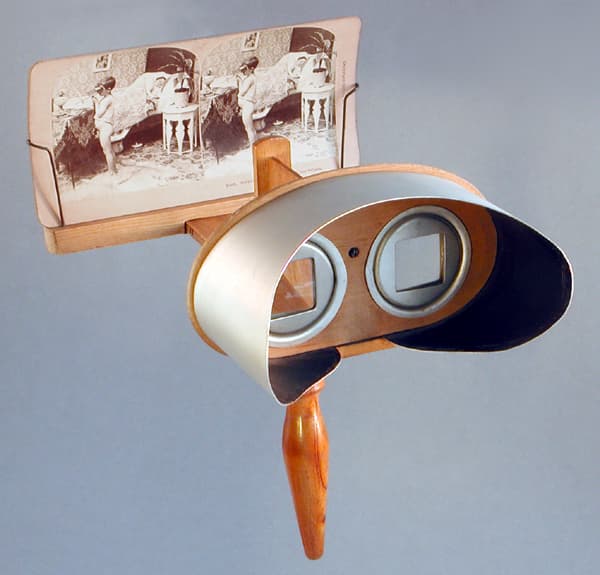
Wheatstone's rival David Brewster made the idea portable. In 1849 he suggested using lenses, which shrank the device into a handheld viewer that Queen Victoria much admired at the Great Exhibition of 1851. After Jules Duboscq improved it in France, a 3D industry appeared almost overnight, producing 250,000 stereoscopes. In 1861 Oliver Wendell Holmes designed a cheaper handheld viewer and deliberately did not patent it; it stayed in production for a century. The same trick, one image per eye, still runs Google Cardboard, the 2014 papercraft viewer that turns a phone into a virtual reality device.
Quiz me
0/3
Recap
Give each eye its own slightly different picture, and the brain builds one 3D scene out of two flat ones.
Surprising fact · About 7% of adults are stereoblind, while around 93% of adults under 60 have functional stereopsis.
Sources (2)
No source, no claim. Every fact in this lesson (17 claims) cites at least one of these.