Why is English spelling so weird?
English froze its spelling on paper right in the middle of the biggest pronunciation shake-up in its history.
▶ Start the storyEnglish spelling looks weird because it is a snapshot of how the language sounded around 600 years ago. Between roughly 1400 and 1700, English went through the Great Vowel Shift, a slow reshuffling of how every long vowel was pronounced. At almost the same moment, spelling started to settle down and get printed. The sounds moved on; the letters stayed put.
Before the shift, English vowels sounded a lot like Italian or German ones. The word 'mite' was said with the vowel we now use in 'meet', and 'meet' and 'meat' were two different sounds. Then the vowels climbed, one pushing the next out of its place like people shuffling along a crowded bench, and the ones at the top turned into glides such as the 'eye' sound in 'mite' today. German went through similar changes a little earlier, but updated its spelling. English did not.
The printing press, which reached England in 1476, made things worse by freezing spellings of the time. Some of its typesetters had trained abroad: that is how 'gost' picked up a Flemish h and became 'ghost', and why a silent e was sometimes added just to make a line of type fit. So when a word looks nothing like it sounds, you are often reading medieval pronunciation, preserved in ink.
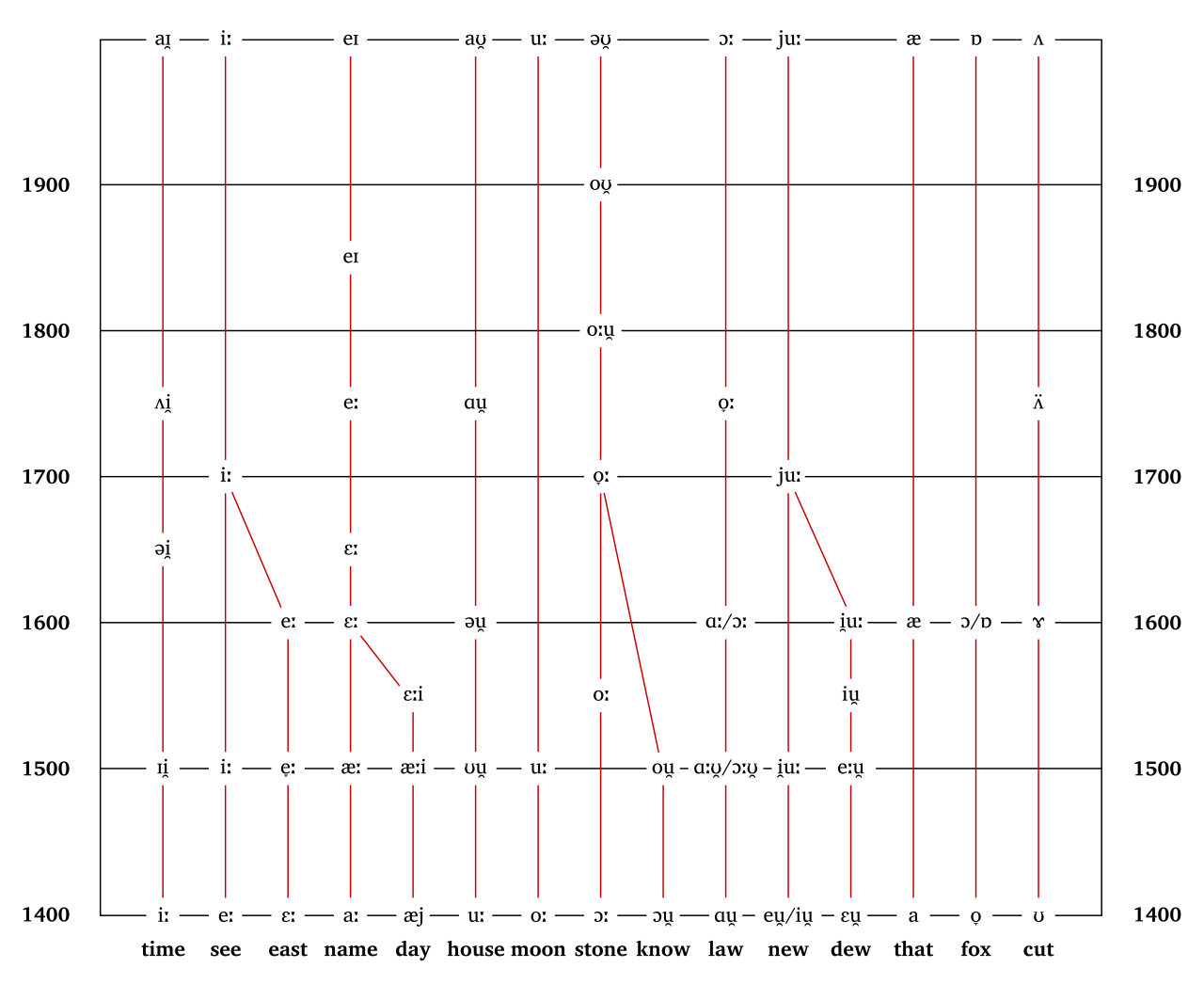
c. 1400
Long vowels begin to shift
1476
Printing press reaches England
c. 1500
First phase complete: 'beet' and 'boot' sound modern
c. 1700
The shift is largely over
1909
Otto Jespersen names it the Great Vowel Shift
Quiz me
0/3
Recap
English writes words the way they were said around 1400 and says them the way they sound after the shift.
Surprising fact · Middle English had 77 different spellings for the word 'right'.
Connects to
- ⚔️ Why do English and French share so many words?
- 🖨️ How did the printing press spread across Europe so fast?
- English orthography
- Middle english
Sources (2)
No source, no claim. Every fact in this lesson (16 claims) cites at least one of these.