Why do high jumpers go over the bar backwards?
A teenager who couldn't master the standard technique invented a weird backwards jump, got called the world's laziest high jumper, and won Olympic gold.
▶ Start the storyHigh jumpers go over backwards because it lets them keep their center of mass low. In the Fosbury flop, the athlete runs in on a curve, leaps, turns their back to the bar and arches over it head first. As the shoulders, back and legs roll over one after another, much of the body is always below the bar. The center of mass travels much lower than in older techniques, and in theory it can even pass under the bar while the body goes over it.
The curved run-up helps too. Leaning into the turn lowers the jumper's center of gravity before take-off and gives them longer to push off the ground.
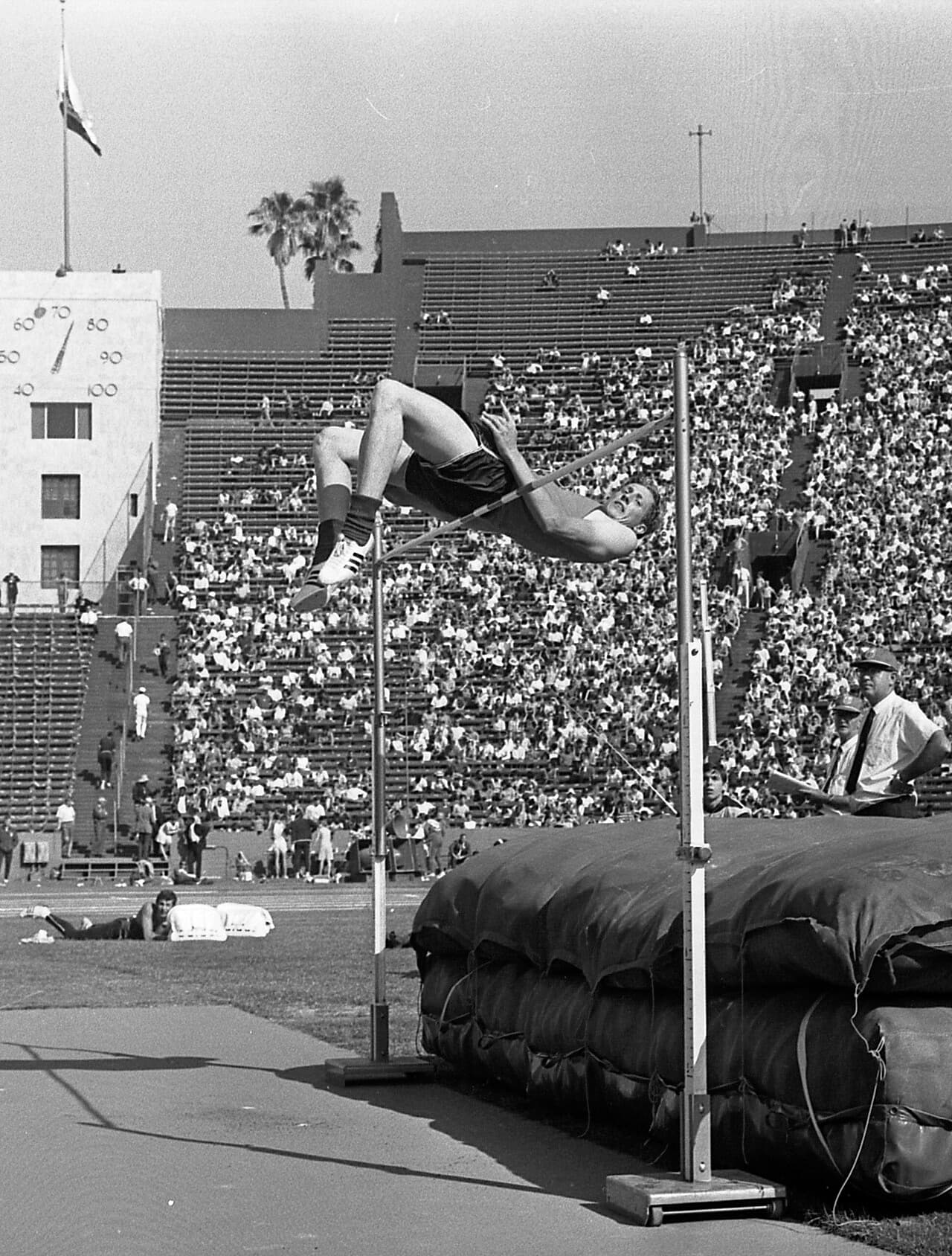
The technique is named after Dick Fosbury, an American teenager who couldn't get the hang of the dominant style, the straddle, where jumpers went over face down and lifted their legs over one at a time. In his second year of high school he failed to clear five feet. So he experimented, since the rules only say you must take off from one foot. His early attempts looked so odd that one historian called them an airborne seizure, and a newspaper captioned his photo World's Laziest High Jumper.
He had timing on his side. Soft foam landing mats, raised about three feet off the ground, had been spreading through American colleges since the late 1950s, so landing on your back was no longer dangerous. In 1968 Fosbury won Olympic gold in Mexico City with an Olympic record of 2.24 metres. Within a few Olympics almost everyone was flopping: of the 36 Olympic medallists from 1972 to 2000, 34 used his style.
Straddle
- Over the bar face down
- Legs lifted over one at a time
- Needs a strong take-off knee
- Last Olympic medal: 1976
Fosbury flop
- Over the bar back first, head first
- Body arched in a rolling motion
- Suits slender, coordinated athletes
- 34 of 36 Olympic medallists, 1972–2000
Quiz me
0/3
Recap
Drape the body around the bar and the center of mass doesn't have to go over it.
Surprising fact · Fosbury developed it as a teenager because he couldn't master the standard straddle technique.
Sources (3)
No source, no claim. Every fact in this lesson (16 claims) cites at least one of these.