Why does sous-vide cook a steak perfectly from edge to edge?
Cooking meat is a ladder of protein changes, one per few degrees. Sous vide lets you stop on exactly the rung you want.
▶ Start the storySous vide cooks a steak evenly from edge to edge because the water bath is set to the exact temperature you want the meat to reach, and the meat can never get hotter than its bath. In a pan or oven, the heat source is far hotter than the target: the outside races ahead while the centre lags, and you have to pull the meat off early and hope. Sealed in a bag in water at, say, 55 °C, the whole piece simply drifts up to 55 °C and stays there.
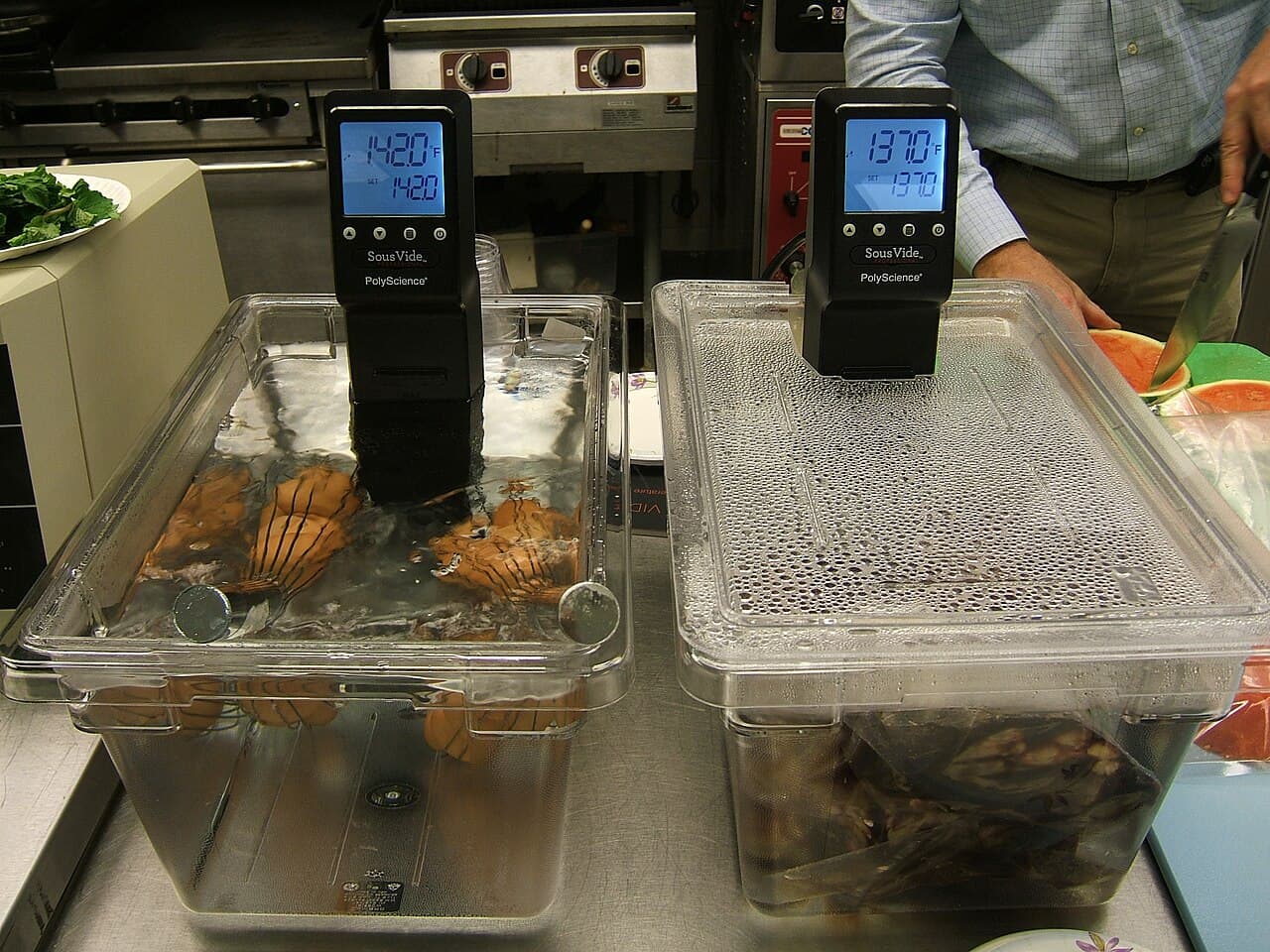
Why does one exact number matter so much? Because cooking meat is a series of protein changes. Heat unfolds proteins by breaking the weak bonds that hold their shape, and the unfolded chains stick together and firm up. In meat, the muscle fibres shrink as they heat, and most of the meat's water sits inside those fibres, so shrinking fibres wring out juice. The tough proteins, actin, myosin and collagen, usually turn tender when held at around 55 to 65 °C for a long time, so a precise bath can soften meat without drying it. Eggs show the principle even more sharply: the white starts to set at 60 °C, the yolk at 65 °C, and ovalbumin, a white protein, only at 82 °C. That is why sous-vide egg recipes name an exact degree.
The catch is time and browning. Low temperatures need long hours, and doubling a steak's thickness makes it take four times as long. Safety, too, depends on time as well as temperature. And browning only happens above the boiling point of water, so chefs sear the meat at the end. The idea is not new: in 1799 Count Rumford tried roasting meat in a potato dryer and found it perfectly done.
Quiz me
0/3
Recap
The bath is the target: pick the degree, and time does the rest.
Surprising fact · Searing doesn't seal in juices; it adds browning, which sous vide can't do because Maillard reactions need temperatures above water's boiling point.
Sources (5)
No source, no claim. Every fact in this lesson (32 claims) cites at least one of these.