Why is the ozone hole healing?
Satellites saw the ozone hole for years, but their software threw the readings away as errors.
▶ Start the storyThe ozone hole is healing because the world stopped making the chemicals that caused it. Those were mostly CFCs, gases once used in fridges, air conditioners and spray cans. When they drift up into the stratosphere, ultraviolet light breaks them apart and frees chlorine atoms, and each chlorine atom can destroy around 100,000 ozone molecules before it is taken out of action. In 1987 nations signed the Montreal Protocol to ban them. Ozone levels stopped falling by the mid-1990s and began recovering in the 2000s, and a 2023 UN assessment expects the ozone layer to be back to 1980 levels around 2040 for most of the world and around 2066 over Antarctica.
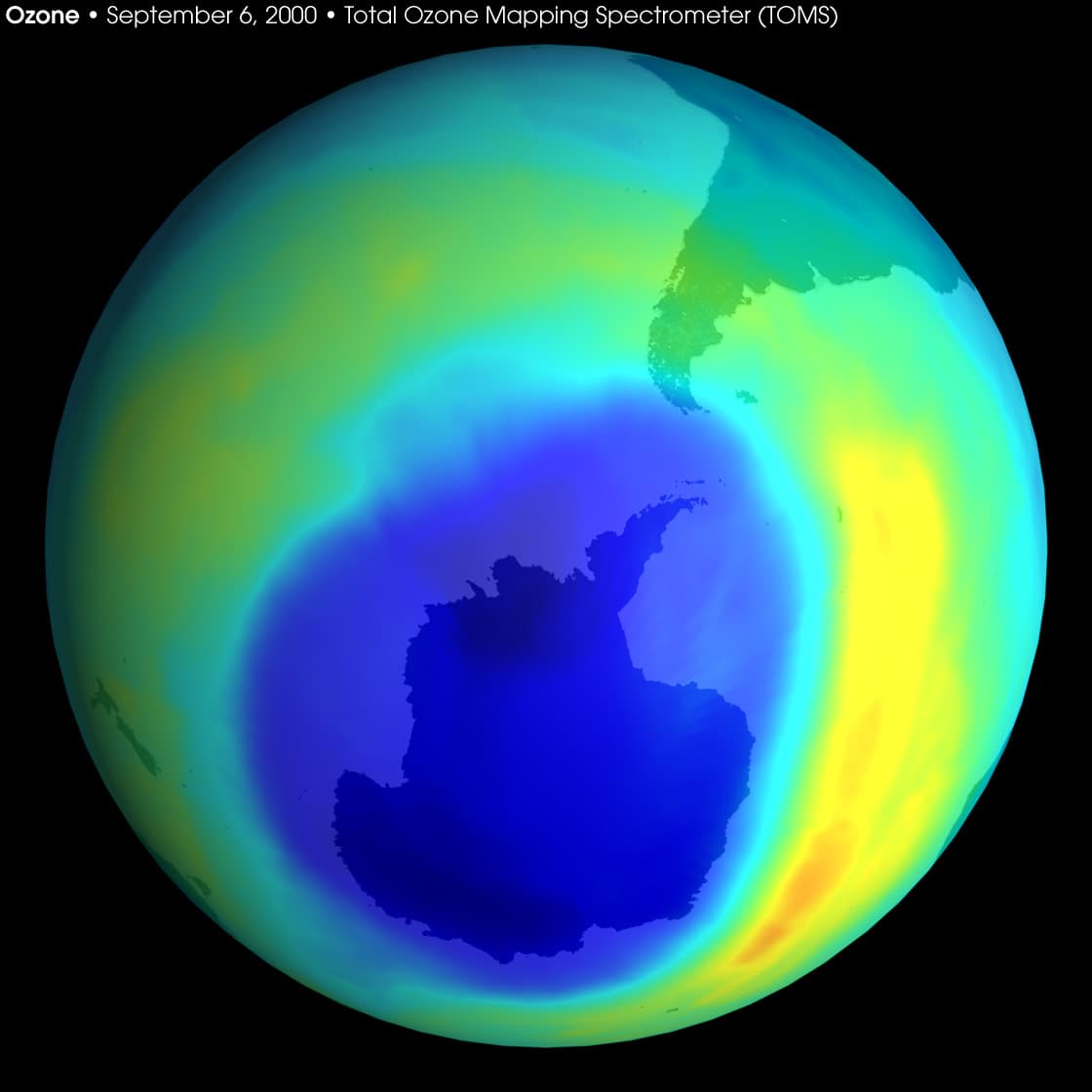
That matters because the ozone layer is Earth's sunscreen. It blocks harmful UVB light, which causes sunburn, skin cancer and cataracts and harms plants and animals.
The discovery is a detective story. In 1974 the chemists Frank Sherwood Rowland and Mario Molina warned that CFCs would release chlorine high in the sky. Industry fought back; the chairman of DuPont called the idea "a science fiction tale". Then, in May 1985, British Antarctic Survey scientists reported a huge springtime loss of ozone over Antarctica, far larger than anyone expected. Satellites should have seen it first, but their software had thrown out the low readings as errors. Rerun without the filter, the data showed the hole going back to 1976.
Rowland, Molina and Crutzen shared the 1995 Nobel Prize in Chemistry, and the Montreal Protocol is considered the most successful international environmental agreement to date.
Quiz me
0/3
Recap
Stop the chlorine at the source and the sunscreen grows back: about 2040 for most of the world, 2066 over Antarctica.
Surprising fact · One chlorine atom can destroy around 100,000 ozone molecules before it is removed.
Connects to
Sources (2)
No source, no claim. Every fact in this lesson (23 claims) cites at least one of these.