Why does a volcanic eruption make the planet freeze?
In 1991 one volcano in the Philippines cooled the whole planet by about half a degree. The trick isn't the ash.
▶ Start the storyA big eruption cools the planet not with its ash, which falls out of the sky within weeks, but with its gas. An explosive volcano can blast sulfur dioxide all the way up into the stratosphere, the calm layer of air above the weather. There it reacts with water vapour and turns into tiny droplets of sulfuric acid. Those droplets reflect sunlight back to space, so less of the Sun's heat reaches the ground.
Height is everything. If the gas stays in the lower atmosphere, rain washes the droplets out within a few days. In the stratosphere there is no rain to clean them away, so the haze circles the globe within weeks and keeps shading the Earth for several years.
We watched it happen in 1991. On 15 June, Mount Pinatubo in the Philippines exploded and sent 20 million tonnes of sulfur dioxide into the sky. Within months a haze of sulfuric acid wrapped the planet, and global temperatures dropped by about half a degree for the next two years.
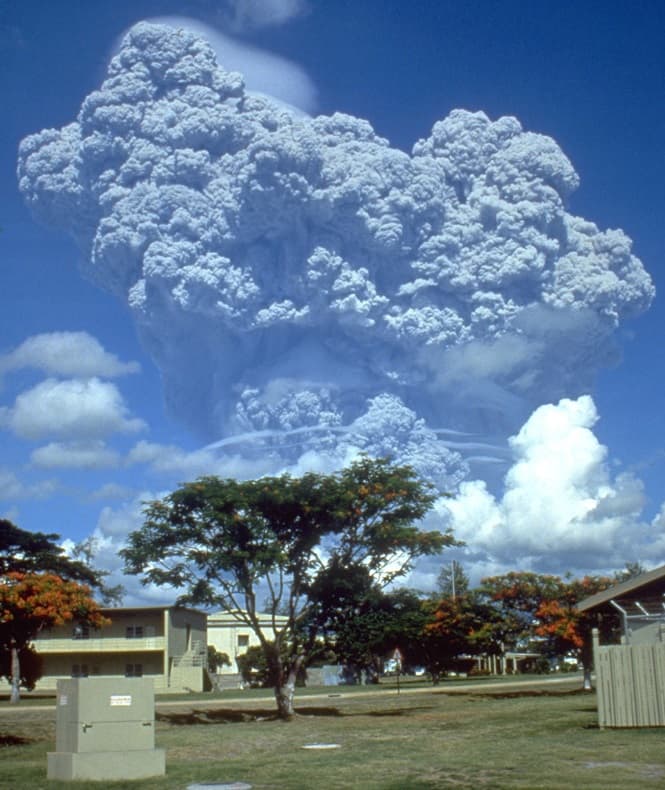
Surprisingly, the biggest explosions aren't always the coldest: eruption size doesn't match how much sulfur a volcano releases. When a sulfur-rich one does hit, the results can be grim. Around the year 536, eruptions brought crop failures, famine and millions of deaths, and a Roman historian wrote that the Sun shone without brightness, as if in eclipse.
Quiz me
0/3
Recap
It's the sulfur, not the ash: droplets in the stratosphere reflect sunlight for years.
Surprising fact · Eruption size doesn't predict cooling: sulfur output does.
Sources (4)
No source, no claim. Every fact in this lesson (14 claims) cites at least one of these.