Why does hot metal glow red, then white?
Heat a piece of metal and it goes from invisible warmth to a dull red glow, then orange, yellow, and finally a blinding white. One equation for that glow forced physics to admit that energy comes in pieces.
▶ Start the storyHot metal glows red, then white, because its glow is a direct readout of its temperature. At room temperature any object radiates mostly invisible infrared. Heat it past about 500 degrees Celsius and it starts glowing dull red. Keep heating and it adds orange, yellow, green and blue light. With all those colours mixed, our eyes see red turn to yellow, then white, then bluish white.
Physicists call the ideal version of this glow black-body radiation, a term Gustav Kirchhoff coined in 1860. Its spectrum has one brightest frequency, and that peak climbs as the object gets hotter. The trouble was the best classical formula for it. It worked well at long wavelengths but went haywire at short ones. It predicted that any hot object should pour out endless energy as ultraviolet light. Nothing like that happens to a glowing coal, so something in the theory was broken.
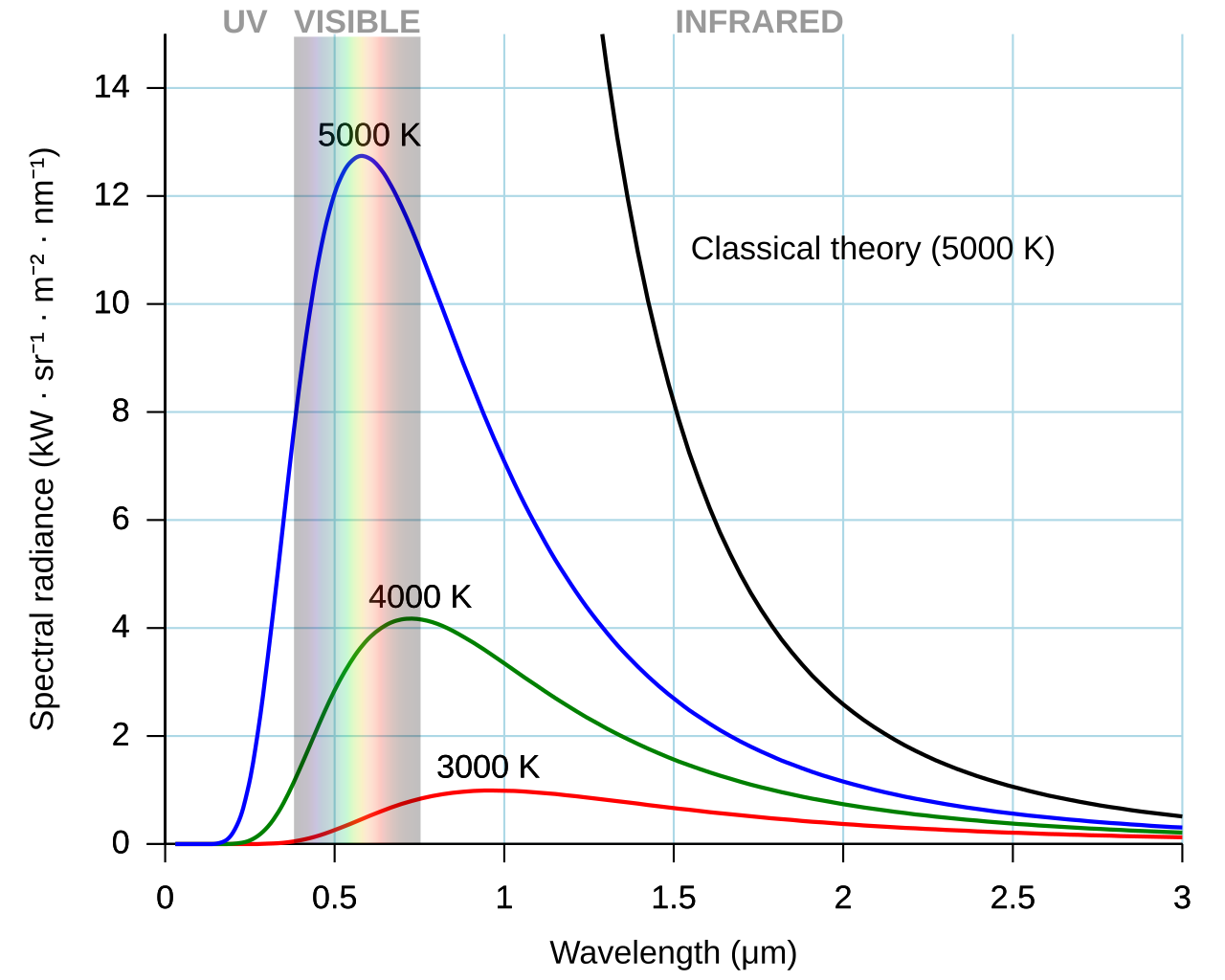
Max Planck found the formula that works, though not for the reason textbooks often give. He wasn't trying to rescue classical physics from that prediction. He was hunting for a formula that matched the measured spectrum, and he presented one in October 1900. In December, explaining why it worked, he had to assume something he didn't like: energy is only handed out in fixed packets, each worth the frequency multiplied by a new constant, h. He later called it an act of despair. He was ready, he said, to sacrifice his convictions about physics.
Those packets are what we now call photons. Five years later, someone would take the packets of light far more literally than Planck ever intended.
Quiz me
0/3
Recap
A black body's glow peaks at one frequency, and that peak climbs as the object gets hotter, so the glow goes from red to yellow to white to blue.
Surprising fact · The 'ultraviolet catastrophe' wasn't Planck's real motivation, and the phrase itself wasn't coined until 1911, after he had already solved the underlying problem.
Sources (3)
No source, no claim. Every fact in this lesson (13 claims) cites at least one of these.