Why does every firework colour come from a different metal?
Strontium burns red, copper burns green, sodium burns a yellow so strong it drowns out almost everything else. Each metal has its own private set of colours, and nothing else makes exactly the same ones.
▶ Start the storyEvery firework colour comes from a different metal because each element's electrons can only sit at a few fixed energy levels, not anywhere in between. Heat the metal and its electrons jump up. When they drop back down, each drop releases light of one exact colour. Strontium's drop makes red, copper's makes green, sodium's makes a yellow so strong it tends to drown out the rest.
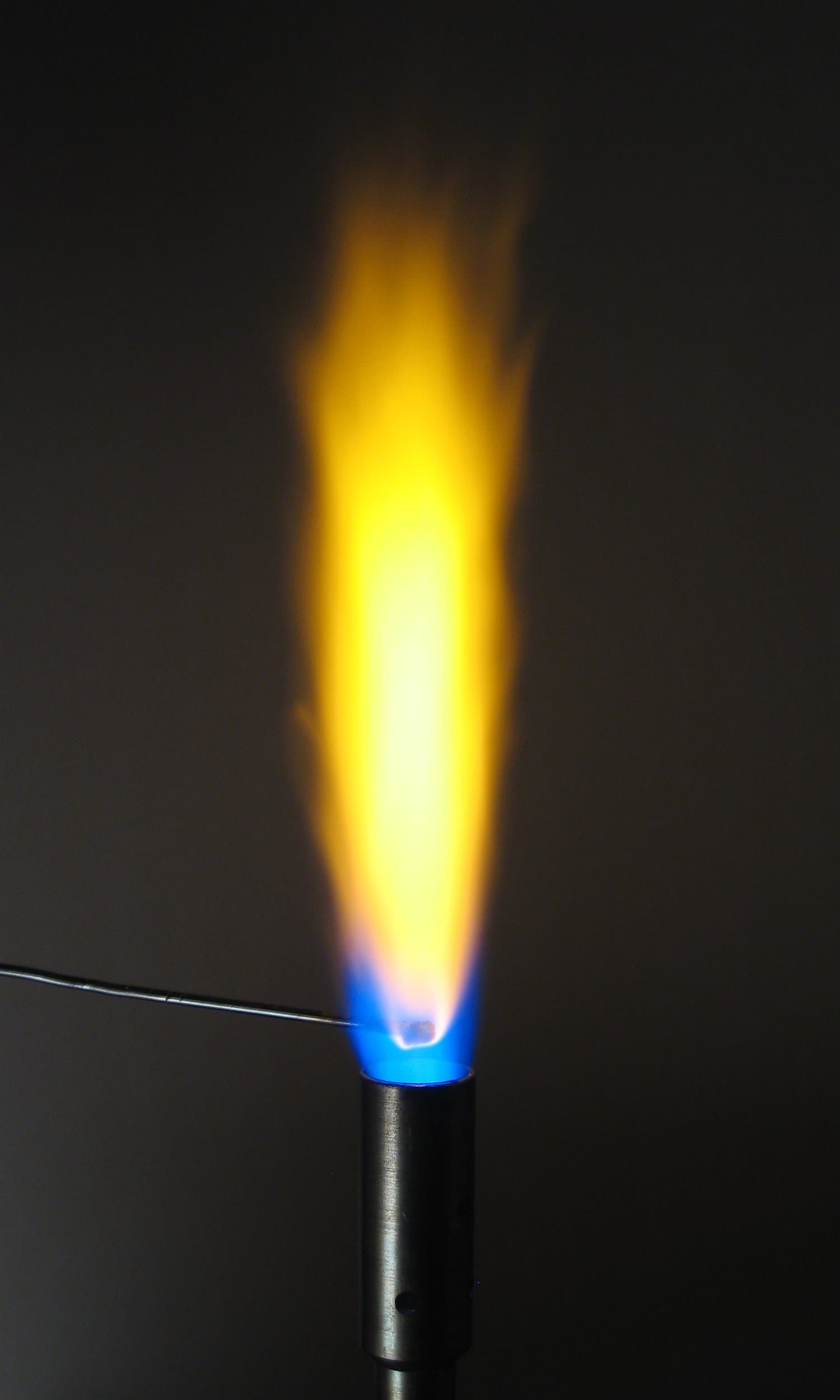
Chemists noticed this long before they understood electrons. In 1855 Robert Bunsen built a burner whose flame itself was almost colourless, so it wouldn't mask the colour of whatever he held in it. He paired it with a prism to build a spectroscope, splitting each flame's glow into narrow, separate lines rather than a single blended colour.
In 1860 Bunsen and his colleague Gustav Kirchhoff spotted lines no known element produced: a sky blue and a dark red. The lines led them to two new metals, which they named caesium and rubidium after the colours of their lines. The same trick found an element nobody expected: in 1868, astronomers watching a solar eclipse caught an unfamiliar yellow line in sunlight. They called it helium, after the Greek word for the Sun, and it took until 1895 for chemists to finally find it on Earth, seeping out of a uranium ore.
That is why spectroscopy works as a fingerprint test: no two elements produce the same set of lines, so reading the lines tells you what's burning, whether it's a firework, a star, or a sample on a lab bench.
Quiz me
0/3
Recap
Every colour an element glows comes from one exact energy jump its electrons make, and no two elements make the same set of jumps.
Surprising fact · Helium was found in the Sun's spectrum in 1868, decades before it was isolated on Earth in 1895.
Sources (5)
No source, no claim. Every fact in this lesson (13 claims) cites at least one of these.