Why was "I think, therefore I am" the one thing Descartes couldn't doubt?
Descartes imagined a supremely cunning demon deceiving him about everything, and found the one belief it could never touch.
▶ Start the storyBecause doubting it proves it. René Descartes wanted one belief so certain that nothing could shake it. Almost everything else he knew might be imagination, deception or a mistake. But the very act of doubting requires someone doing the doubting. As he put it in a margin note, "we cannot doubt of our existence while we doubt."
He pushed the test as far as it could go. Suppose an evil demon of supreme power were deceiving him about the sky, the earth, even his own body. Even then, he would have to exist in order to be deceived. That is the cogito: "I think, therefore I am." Like Archimedes asking for one fixed point to move the earth, Descartes had found one unshakable certainty to build on.
Step 1: Doubt the senses
What I perceive might be imagination or a mistake
Step 2: Imagine a deceiver
An evil demon fooling me about everything
Step 3: Notice the doubting
To be deceived, someone must be there
Step 4: I think, therefore I am
One certainty survives
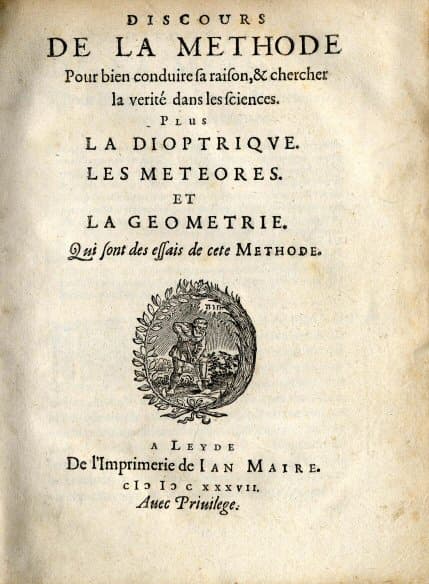
Fun detail for French speakers: he first published it in French, as "je pense, donc je suis", in his 1637 Discourse on the Method, precisely so more people could read it than Latin would allow.
The cogito has limits and critics. It only proves your own existence, not anyone else's. Pierre Gassendi objected that it sneaks in an "I": strictly, Descartes could only say that thinking is happening. And Descartes wasn't the first. Augustine had written "if I am mistaken, I exist" twelve centuries earlier; when a friend pointed this out, Descartes went to the library to check, and replied he was glad to agree, if only to hush the little minds.
Quiz me
0/3
Recap
You can doubt almost everything, except that you are the one doing the doubting.
Surprising fact · Augustine had said something similar twelve centuries earlier, and Descartes went to a library to check.
Sources (2)
No source, no claim. Every fact in this lesson (16 claims) cites at least one of these.