Is there really a "you" behind your thoughts, or just the thoughts themselves?
David Hume searched inside himself for his self and kept stumbling on single perceptions, heat or cold, love or hatred, never a self having them.
▶ Start the storyJust the thoughts, says bundle theory. There's no separate self sitting behind them. The Scottish philosopher David Hume went looking for one. "When I enter most intimately into what I call myself," he wrote, "I always stumble on some particular perception or other." Heat or cold, love or hatred, pain or pleasure. Never a self on its own.
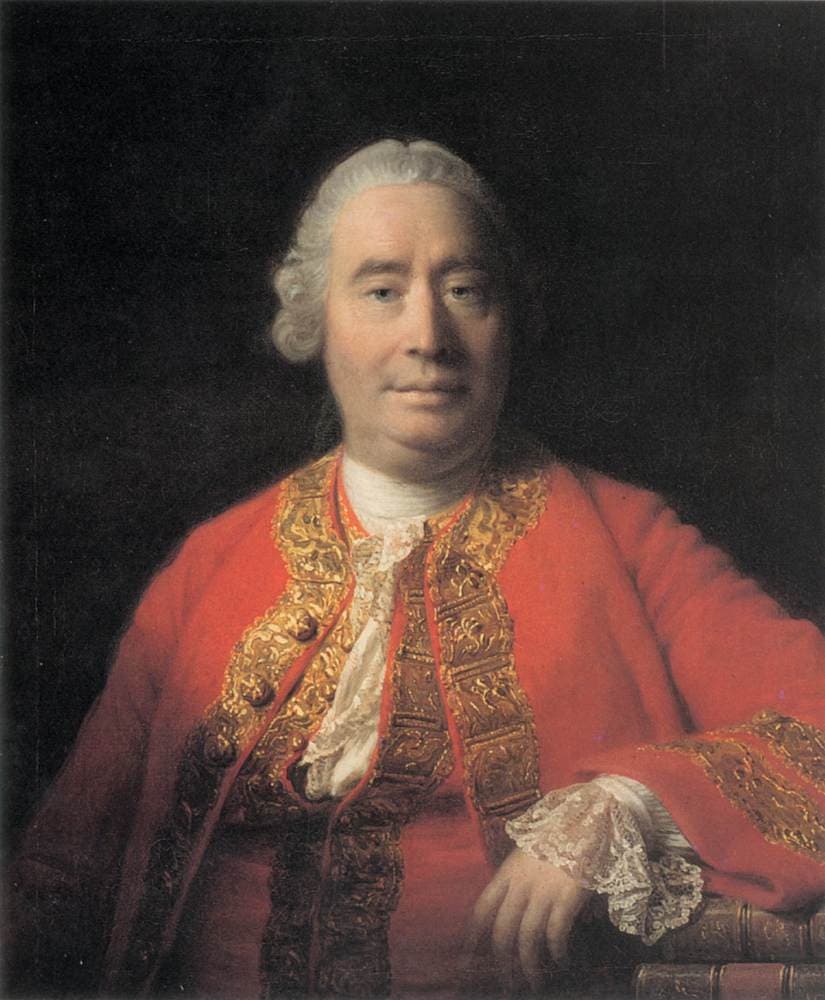
So Hume concluded that people are nothing but a bundle of perceptions. These follow each other with inconceivable rapidity, in perpetual flux. That clashes with Descartes, for whom the "I" in "I think" was a thinking thing behind its thoughts. John Locke had already admitted how thin that idea of substance is. Apart from its qualities, he could only call it "something, I know not what."
Ego theory (Descartes)
- A thinking self stands behind every thought
- The self is a substance that persists
Bundle theory (Hume)
- Only perceptions are ever found
- "Self" is just the bundle, not an owner of it
Buddhist philosophy has a related idea: the doctrine of anattā, or non-self. It holds that no unchanging, permanent self exists in anything. The philosopher Chandrakirti compared the self to a cart. A cart isn't something other than its parts. Yet it isn't simply its parts, their pile or their shape either. Search the wheels and boards for the "real" cart, and there's no extra thing to find.
The big objection is called compresence. If nothing does the bundling, what holds these perceptions together as one stream, as you? Critics think some unifying self must be doing that work. Bundle theorists can reply with Locke's point: no one has said what such a self would be.
Quiz me
0/3
Recap
Bundle theory's hardest objection is explaining compresence: what makes a set of perceptions belong together as one stream, rather than as scattered, unconnected flashes, if nothing is doing the bundling.
Surprising fact · The Buddhist philosopher Chandrakirti compared the self to a cart: search the wheels and boards for the "real" cart and there's no extra thing to find.
Sources (3)
No source, no claim. Every fact in this lesson (14 claims) cites at least one of these.