Did a jammed camera really invent movie special effects?
Georges Méliès said his camera got stuck and a bus turned into a hearse. The truth involves an axe, a dummy and Mary, Queen of Scots.
▶ Start the storyProbably not, although it makes a great story. The French magician turned filmmaker Georges Méliès wrote that his rudimentary camera jammed one day while he was filming the Place de l'Opéra in Paris. He stopped, freed the film and started again. When he projected the result, a Madeleine-Bastille bus suddenly turned into a hearse, and men turned into women. The stop trick, he said, had been invented by accident.
The trick itself is simple: film a scene, stop the camera, change something, then carry on with exactly the same framing, and the change seems to happen by magic. But Méliès was not the first. In 1895, for an Edison film about the execution of Mary, Queen of Scots, Alfred Clark stopped the camera as the executioner raised his axe, had the actors freeze, swapped the actor playing Mary for a dummy, and started filming again. The axe came down on the dummy's neck. It is commonly accepted as the first special effect in a motion picture, and the film scholar Jacques Deslandes thinks Méliès most likely learned the trick by studying a print of it.
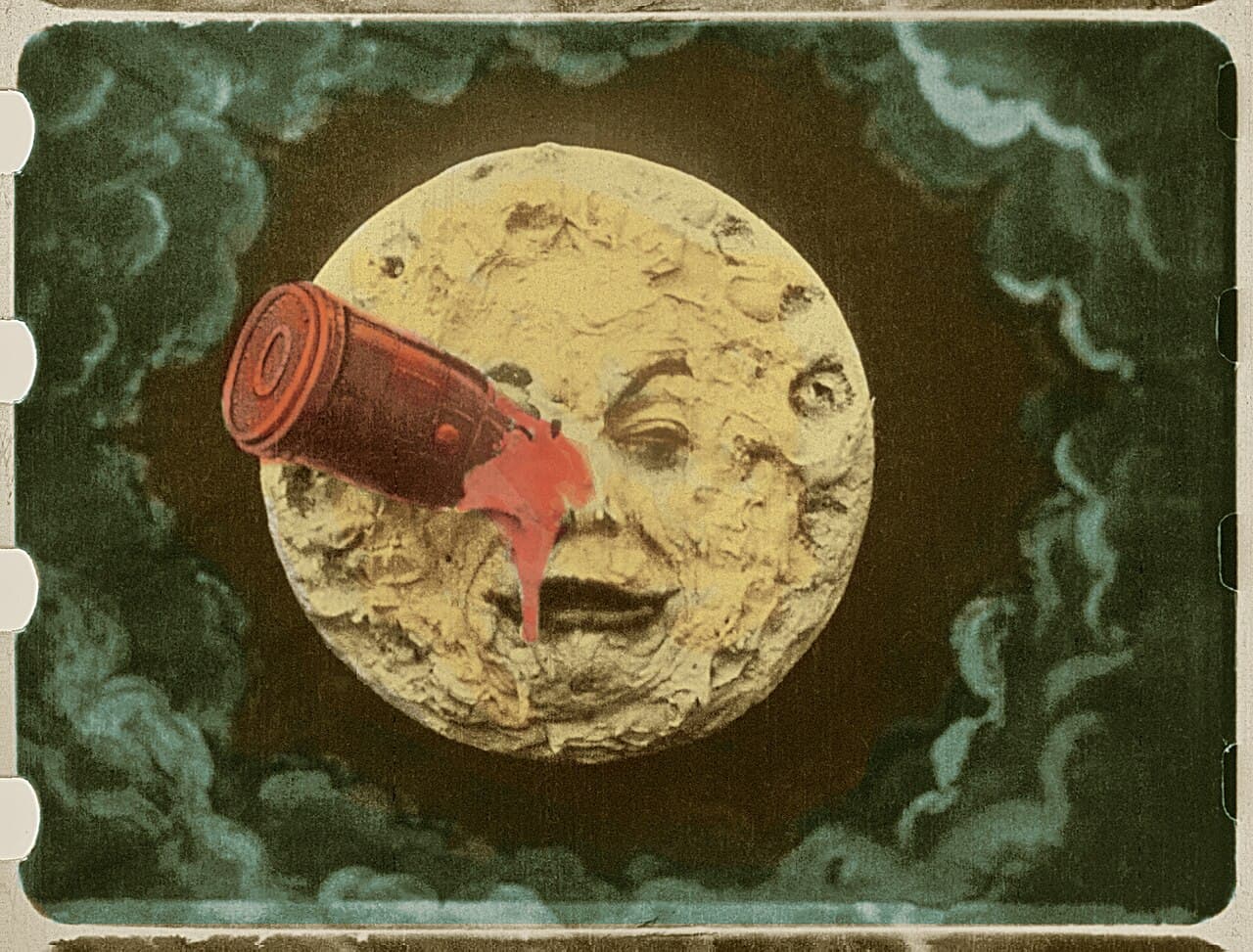
What Méliès did was turn a trick into an art. A stage magician who ran the Théâtre Robert-Houdin in Paris, he matched his frames so carefully in editing that two separate shots looked like one, and the hand-painted colour on many of his films hid the cuts like sleight of hand. Across more than 500 films, he made people vanish, transform and fly to the Moon.
Step 1: Film the scene
The camera stays perfectly still
Step 2: Stop the camera
Everyone freezes in place
Step 3: Swap something
An actor for a dummy, a person for nothing
Step 4: Film again
Same framing as before
Step 5: Match the cut
Careful editing hides the join
Quiz me
0/3
Recap
Stop, swap, restart: the oldest special effect is a magician's trick done with a camera, perfected by careful editing.
Surprising fact · Méliès said he found it when his camera jammed, but Alfred Clark had already used it in 1895 to behead Mary, Queen of Scots with a dummy.
Connects to
- 🚀 Where does cinema's famous rocket in the Moon's eye come from?
- 👻 Did the man behind 'Pepper's Ghost' actually invent it?
- 🎩 Why did cinema's great special-effects pioneer end up selling toys at a train station?
- 🚂 Did the first movie audiences really run from a train on the screen?
- 🎬 How do still pictures become a moving film?
Sources (3)
No source, no claim. Every fact in this lesson (21 claims) cites at least one of these.