Why did cinema's great special-effects pioneer end up selling toys at a train station?
The French Army melted down over 400 of his films for their silver and turned the celluloid into shoe heels. By 1925, Georges Méliès was working at a candy and toy stand in a Paris train station.
▶ Start the storyBecause his career collapsed, and then much of his work was destroyed. When Georges Méliès broke his contract with the distributor Pathé in 1913, he had nothing to cover what he owed the company, and he was left bankrupt and unable to make films. During the First World War, the French Army confiscated over four hundred of his original prints and melted them down for their silver and celluloid, which it used to make shoe heels. By December 1925 he was largely forgotten and financially ruined, and he and his wife, the actress Jehanne d'Alcy, scraped together a living at a small candy and toy stand she owned in the main hall of the Gare Montparnasse in Paris.
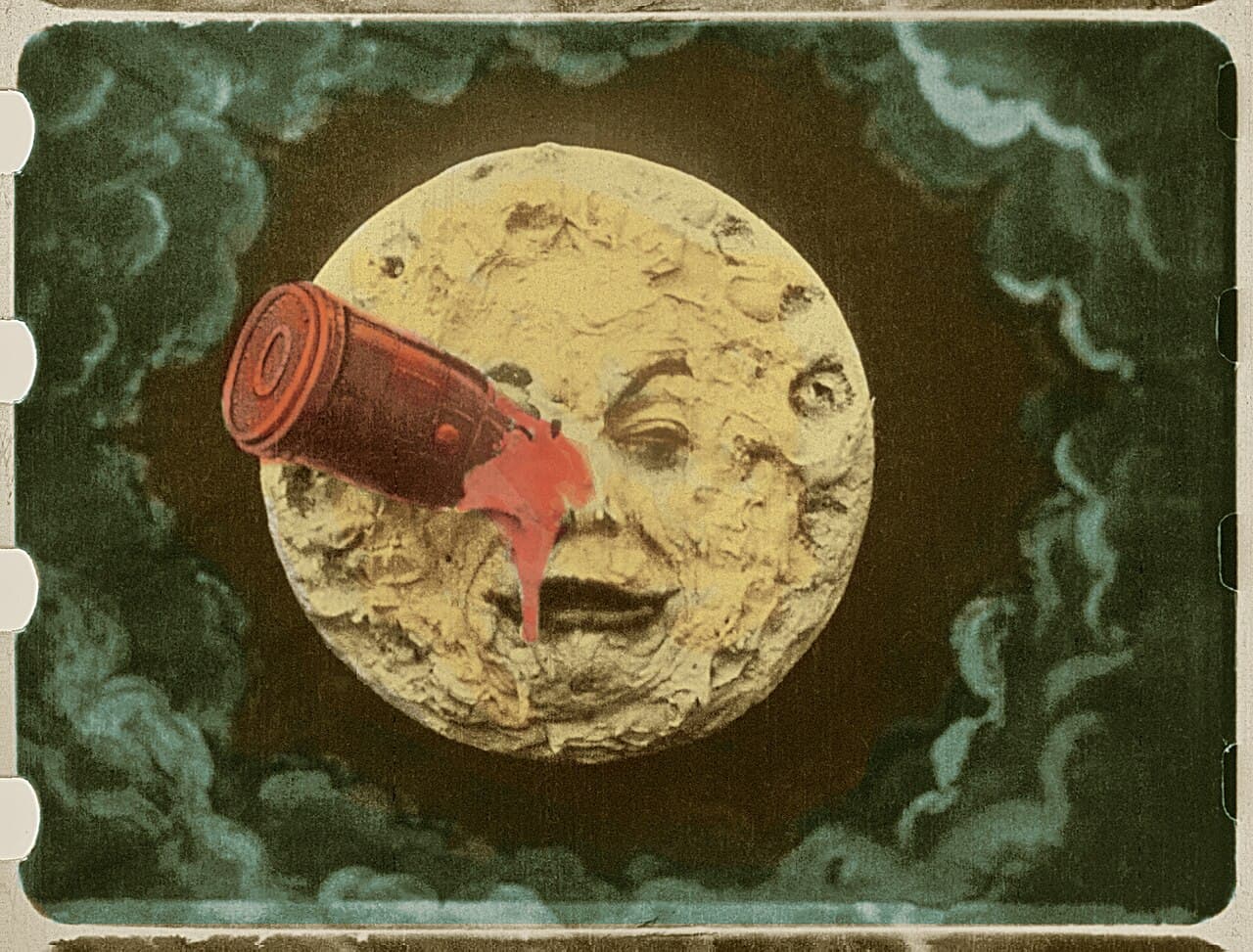
It was a long way down. Méliès, a magician turned filmmaker, had popularized tricks like substitution splices, multiple exposures, dissolves and hand-painted colour. From about 1897 to 1912, colour prints of films such as A Trip to the Moon were painted at the Paris lab of Élisabeth and Berthe Thuillier, where two hundred women worked directly on the film stock with brushes, each assigned one colour, assembly-line style. A coloured print sold for 1,000 francs in France, against 560 for black and white.
The station stand is also where he was found again. In 1926 the magazine Ciné-Journal located him there and commissioned a memoir, and by the late 1920s several journalists were researching his work. In October 1931 he was made a Chevalier de la Légion d'honneur, the medal presented by Louis Lumière, who called him the "creator of the cinematic spectacle". The honours did not end his poverty: he wrote to a fellow filmmaker that it was hard to work 14 hours a day without Sundays or holidays, in an icebox in winter and a furnace in summer.
Quiz me
0/3
Recap
A film pioneer's legacy can be destroyed by ordinary economic pressure, bankruptcy, and a war, long before historians realize what was lost.
Surprising fact · The French Army melted down over 400 of Méliès's films during World War I for their silver and celluloid, turning the celluloid into soldiers' shoe heels.
Connects to
- 🎞️ How did cartoons get real depth decades before 3D existed?
- 🎩 Did a jammed camera really invent movie special effects?
- 🚂 Did the first movie audiences really run from a train on the screen?
- 🌈 Why do old Technicolor films look more colourful than real life?
- 🚗 How did a wrong turn in Sarajevo help start World War I?
- Sound film
Sources (2)
No source, no claim. Every fact in this lesson (11 claims) cites at least one of these.