Why did astronomers once think a star's signal came from little green men?
In 1967 a PhD student spotted a radio blip ticking every 1.337 seconds. Her team nicknamed it LGM-1, for little green men.
▶ Start the storyFor a few weeks in 1967, the strange radio signal ticking every 1.337 seconds was so regular that it looked artificial, so its discoverers jokingly called it LGM-1, for "little green men". It turned out to be a pulsar: a dead star, a neutron star, spinning fast and sweeping beams of radiation through space. We only catch a beam when it points at Earth, like the light of a lighthouse, so the star seems to blink.
The person who found it was Jocelyn Bell, a PhD student at Cambridge who had spent two years helping build the radio telescope. Its output came on paper, and she sometimes read 29 metres of chart per night, by hand. Among the squiggles she noticed a "bit of scruff" that kept coming back with the stars. Her supervisor, Antony Hewish, first thought it was man-made interference. On 28 November they recorded it in detail: perfectly spaced pulses, like nothing ever seen in the sky.
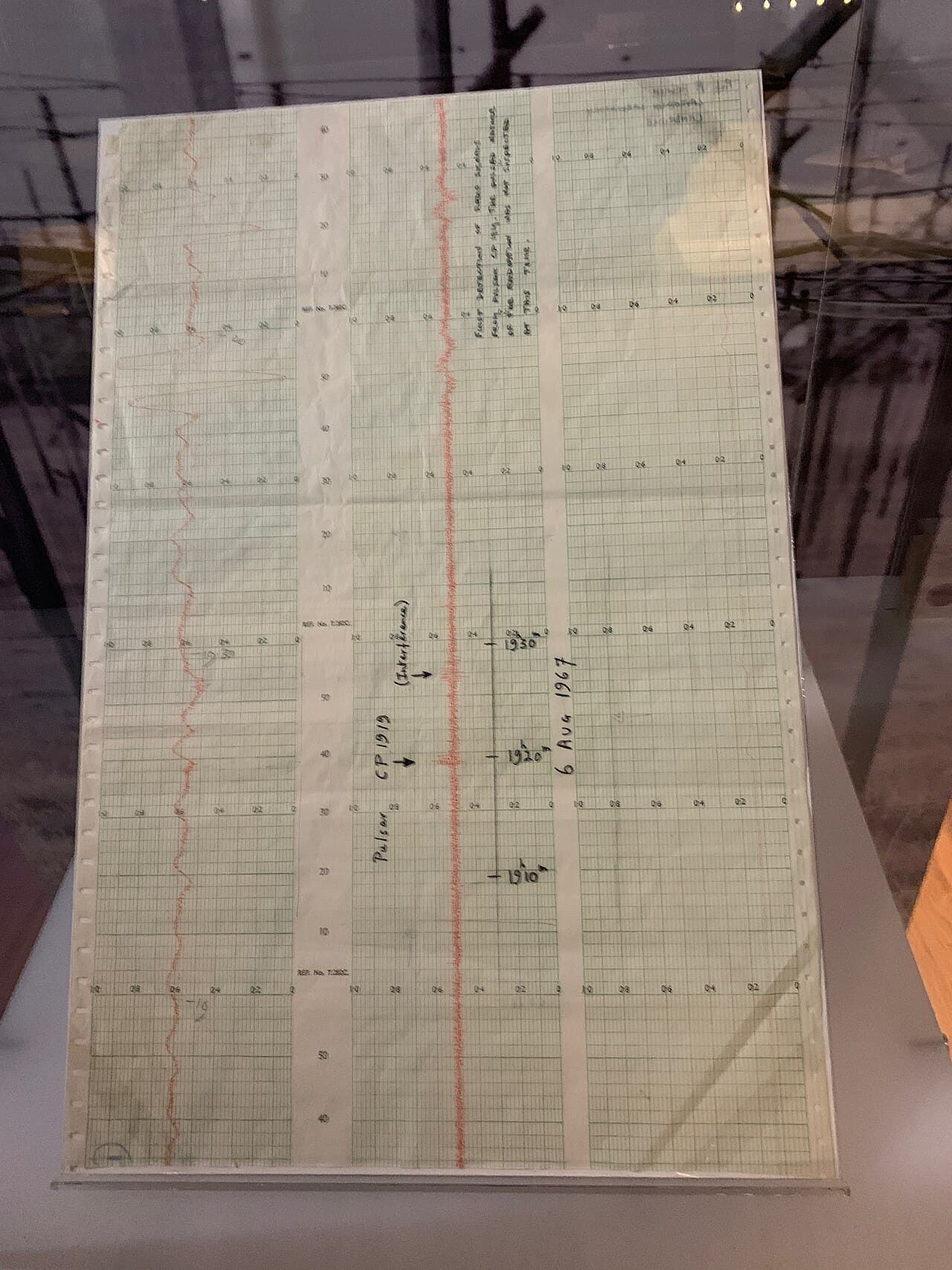
The alien idea died on 21 December, when Bell found a second pulsar in another part of the sky. Two civilizations signalling on the same odd channel seemed unlikely; a new kind of star did not. Pulsars are now some of the most precise clocks in the universe, and they have revealed gravitational waves and the first planets beyond the Solar System.
Quiz me
0/3
Recap
A collapsing star keeps its spin while shrinking to a tiny size, so it whirls fast enough to blink at us with clockwork precision.
Surprising fact · Jocelyn Bell found the first one as a PhD student by reading up to 29 metres of paper chart a night, yet the Nobel Prize went to her supervisor.
Connects to
- ☄️ Why are particles from deep space passing through your head right now?
- 🦢 Why does a scientific theory have to be able to fail?
- 〰️ How did we feel two black holes collide a billion light-years away?
- 💿 What message did we send to aliens on the Voyager Golden Record?
- 🪐 How do we find planets around other stars if we can't see them?
Sources (2)
No source, no claim. Every fact in this lesson (18 claims) cites at least one of these.