How did we feel two black holes collide a billion light-years away?
In 2015 a ripple in spacetime changed the length of a giant detector by a thousandth of the width of a proton. It sounded like a bird's chirp.
▶ Start the storyWe felt it as a ripple in spacetime itself. When two black holes spiral into each other, they shake the curvature of space and time, and that disturbance spreads outward at the speed of light as a gravitational wave. On 14 September 2015, one such ripple, set off about 1.3 billion light-years away by black holes of 36 and 29 times the Sun's mass, swept through Earth. It changed the length of the LIGO detectors by a thousandth of the width of a proton.
LIGO measures that with light. Each observatory is an L-shaped vacuum tube 4 kilometres on each side. A laser beam is split in two, sent down both arms, bounced back and forth between mirrors, then recombined. Normally the two beams cancel out and no light reaches the detector. If a passing wave changes the length of one arm relative to the other, the beams fall out of step and light leaks through.
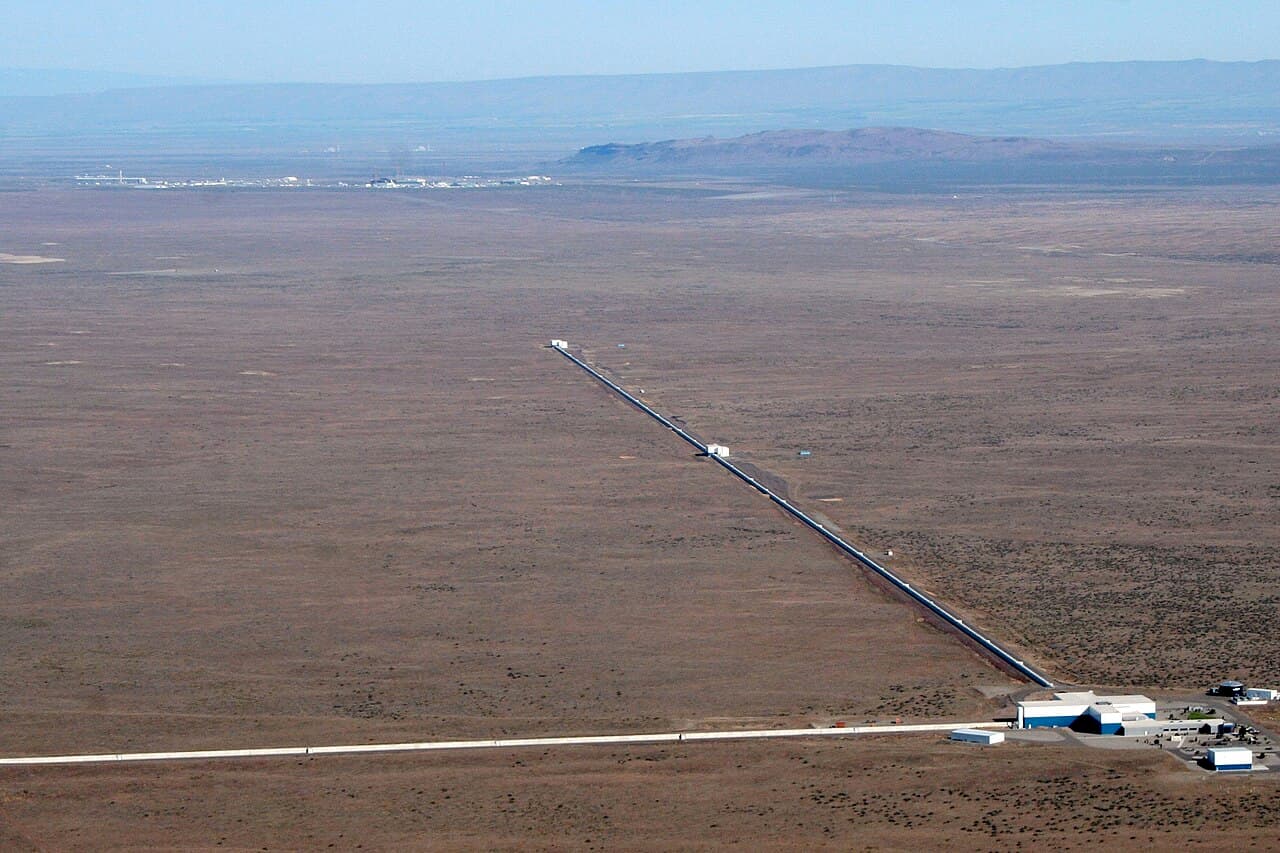
Two observatories, 3,002 km apart in Louisiana and Washington, caught the same signal, Livingston seven milliseconds before Hanford, just what a wave travelling at light speed would do. Turned into sound, it lasted just over 0.2 seconds and swept up from 35 to 250 hertz, a rising chirp, because each orbit of the doomed pair was faster than the last.
Einstein predicted these waves in 1916 but doubted anyone would ever detect anything so tiny, and in 1936 he even briefly argued they didn't exist. In its last milliseconds, the merger poured out more power than all the stars in the observable universe shine as light. The 2017 Nobel Prize went to Rainer Weiss, Barry Barish and Kip Thorne for building the detector that finally heard it.
Quiz me
0/3
Recap
LIGO splits a laser between two 4-km arms; a passing wave changes their lengths differently, so the beams stop cancelling and light leaks out.
Surprising fact · The first wave detected changed the length of LIGO's detectors by a thousandth of the width of a proton, and turned into sound it chirps like a bird.
Connects to
- 📡 Why did astronomers once think a star's signal came from little green men?
- 🌀 Why did Einstein say gravity isn't really a force?
- 🌈 If radio waves and X-rays are light too, why can't we see them?
- 🕳️ What happens at a black hole's point of no return?
- 🌊 Why do ocean tides actually rise and fall?
- Gravitational time dilation
Sources (4)
No source, no claim. Every fact in this lesson (29 claims) cites at least one of these.