How does a switch with no moving parts run every computer on Earth?
In December 1947, two Bell Labs physicists touched two gold wires to a crystal and made a signal come out bigger than it went in.
▶ Start the storyEvery computer is built from billions of tiny switches, and almost all of them are transistors. A transistor flips a current on or off using only a voltage on one of its terminals, with no lever, spring, or moving part to wear out: a small signal on one pair of terminals controls a much larger current through another pair.
The first one was built by hand. In late 1947 at Bell Labs, John Bardeen and Walter Brattain touched two gold wires to a crystal of germanium and watched a weak signal come out stronger than it went in. Colleague William Shockley pushed the work further, and the three shared the 1956 Nobel Prize in Physics for it. A co-worker coined the name transistor, short for transresistance.
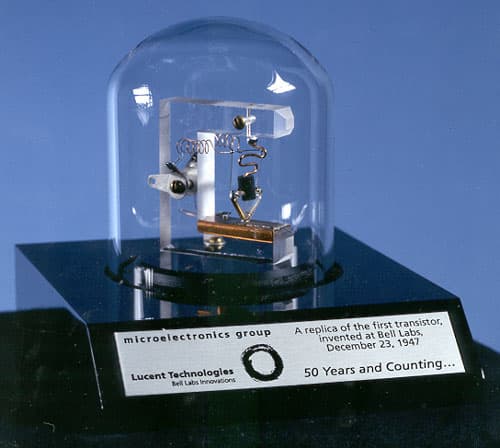
Before this, switches were vacuum tubes: glass bulbs with a hot wire inside, like tiny light bulbs. Their filaments burned out constantly. The 1946 ENIAC computer, built from over 17,000 tubes, lost one to failure roughly every two days, and someone had to hunt down which one. Transistors needed no hot filament, so they ran cooler, smaller, and on far less power.
The version in your phone today is the MOSFET, invented at Bell Labs by 1960. A voltage on its gate switches a channel of current on or off beneath it. It is now the most manufactured object humans have ever made: over 13 sextillion of them by 2018, each one a switch with nothing to burn out.
Quiz me
0/3
Recap
A transistor switches a large current using a small voltage and no moving parts, which is why it could replace the vacuum tube and shrink to fit billions on a chip.
Surprising fact · The first transistor was built by hand at Bell Labs in December 1947, and its modern descendant, the MOSFET, is the most manufactured object in history.
Sources (3)
No source, no claim. Every fact in this lesson (14 claims) cites at least one of these.