Why does a USB drive remember your files with no power at all?
Flash memory got its name because erasing it reminded an engineer of a camera's flash. Inside, it keeps your files as electrons walled in by insulation.
▶ Start the storyA USB drive keeps your files with the power off because each bit is stored as electrons trapped on a tiny 'floating gate' inside a transistor, walled in on every side by insulating oxide. Nothing needs to keep flowing: the electrons stay put because they have no conducting path out.
Each memory cell is like an ordinary transistor with two gates instead of one. The control gate on top works like any transistor gate. Beneath it, between the control gate and the channel where current flows, sits the floating gate, wrapped in oxide. Electrons can be pushed through that oxide onto the floating gate, or pulled off again, by an effect called Fowler–Nordheim tunneling: that is writing and erasing.
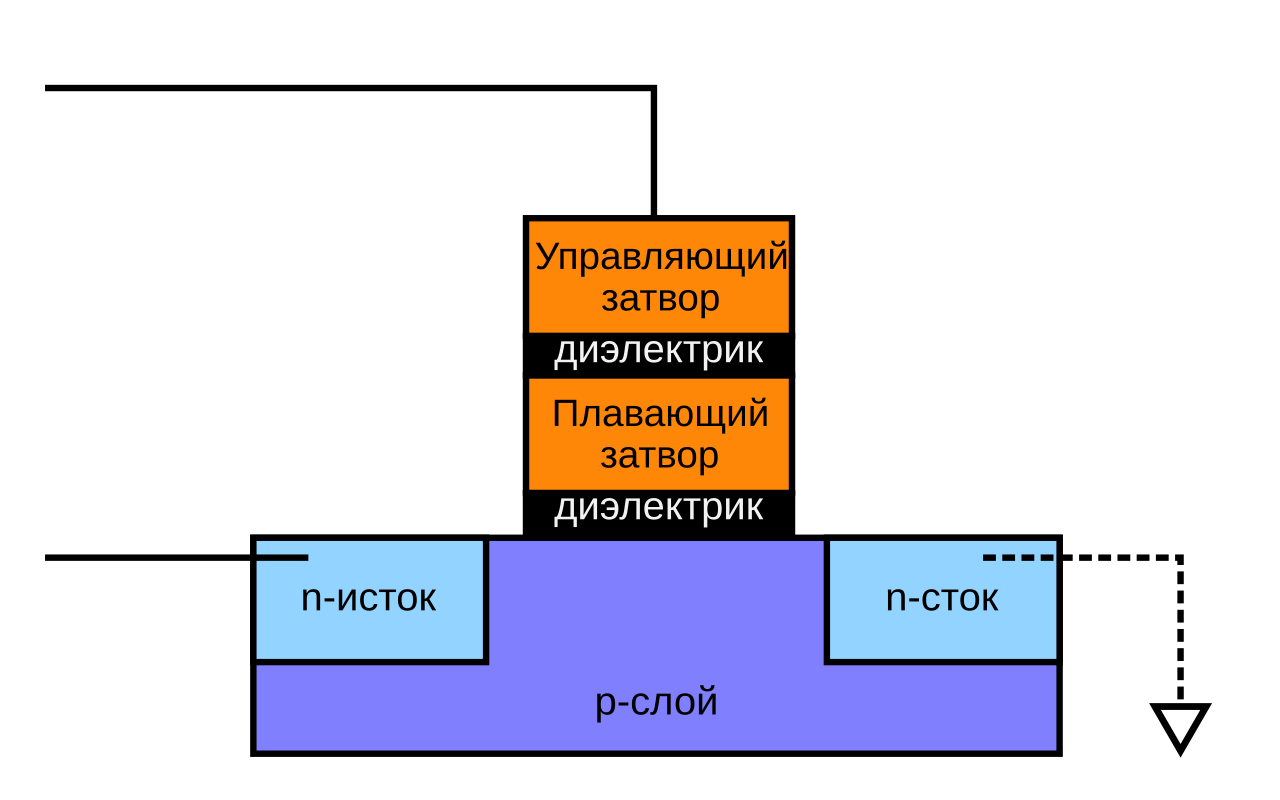
Reading the bit is a matter of testing the transistor. Charge on the floating gate screens the control gate's electric field, so the cell needs a higher voltage to conduct. The chip applies an in-between voltage and checks whether current flows: if it does, the floating gate is empty.
The trap isn't perfect. Stored data is steadily lost as electrons slowly escape, faster when it's hot, and the very strong electric field used for writing gradually damages the thin oxide, which is why each block can take only a limited number of rewrites. The name came from Toshiba, where Fujio Masuoka invented flash memory in 1980: his colleague Shōji Ariizumi said erasing it reminded him of a camera's flash.
Quiz me
0/3
Recap
Electrons sealed on a floating gate by insulating oxide keep the data with the power off, but they slowly leak, and every write wears the oxide a little.
Surprising fact · The name 'flash' came from Shōji Ariizumi, who thought erasing the memory looked like a camera's flash.
Sources (1)
No source, no claim. Every fact in this lesson (18 claims) cites at least one of these.