How did Notre-Dame survive revolution, near-arson, and a catastrophic fire?
Revolutionaries melted its bronze, rebels almost torched it on purpose, and in 2019 a stone ceiling alone kept a burning roof from gutting the whole cathedral.
▶ Start the storyBy a mix of restraint, rescue and stone. Notre-Dame de Paris was stripped during the Revolution, almost burned by the Communards in 1871, and set ablaze in 2019; it survived because the Communards drew back, because a novel inspired its restoration, and because its stone vault held when the roof burned. Construction began in 1163 and was largely finished by 1260, and its closest brushes with destruction came centuries later. During the French Revolution in the 1790s, revolutionaries stripped and melted down its bronze and lead, and in 1793 it was converted first into a Temple of Reason and then a Temple of the Supreme Being, with much of its religious imagery damaged or destroyed outright. Napoleon's Concordat of 1801 gave its use, though not its ownership, back to the Catholic Church, and in 1804 he crowned himself Emperor there.
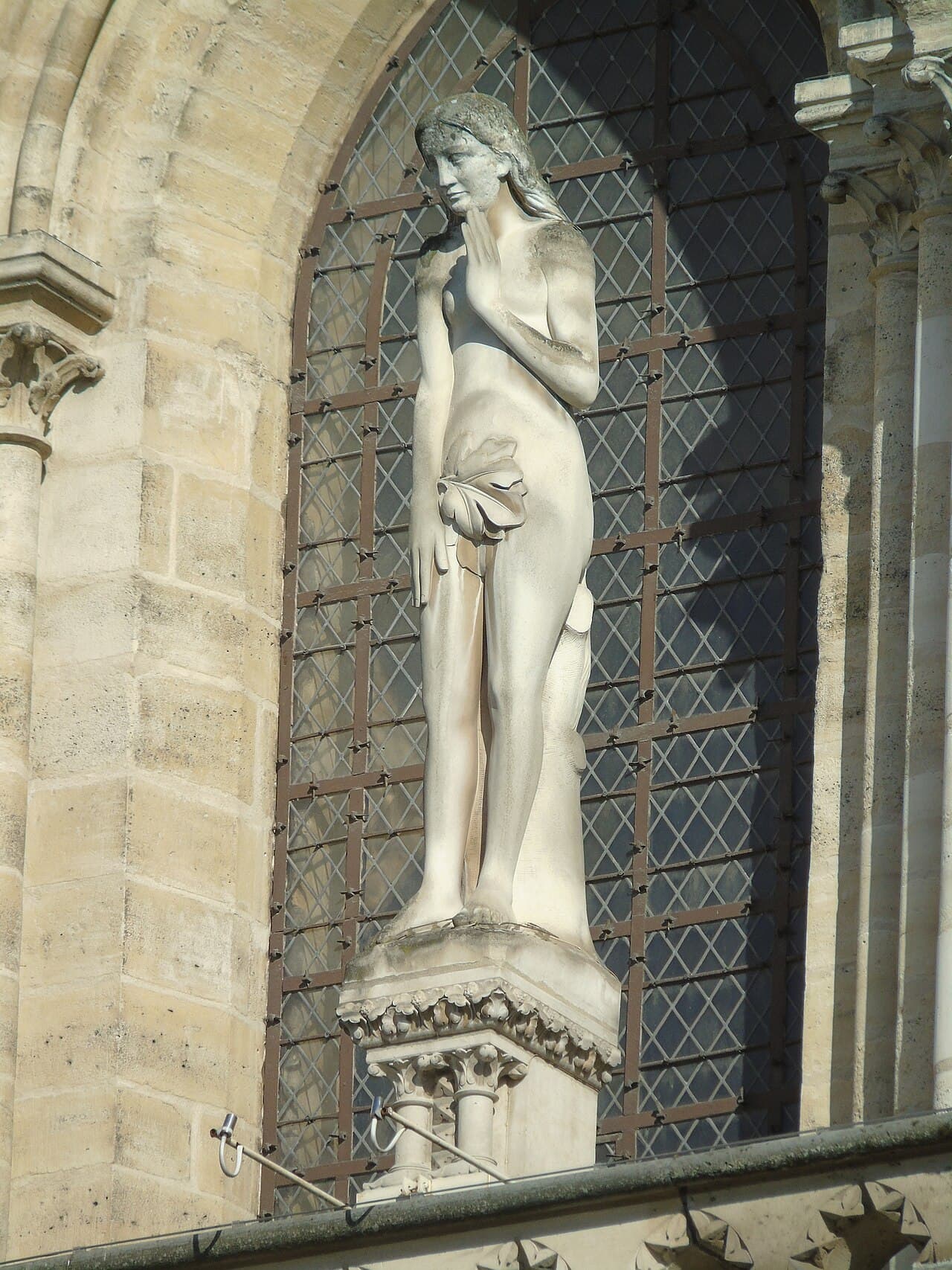
The building came even closer to disappearing entirely in 1871. As the radical Paris Commune collapsed at the end of its brief rule, the Communards actually prepared to burn Notre-Dame down, and they only abandoned the plan because doing so would necessarily have set fire to a crowded neighboring hospital for the elderly as well. A different kind of rescue came a few decades earlier, when Victor Hugo's 1831 novel inspired the interest that led to a major restoration between 1844 and 1864, supervised by Eugène Viollet-le-Duc.
Nothing tested the building quite like the fire of 15 April 2019, though. A blaze that started in the roof space, likely from a cigarette or an electrical fault, destroyed the entire wooden spire and most of the wooden roof, and nearly cost the cathedral far more: the fire alarm sent a guard to check the wrong building entirely, and by the time the mistake was caught and the actual fire found, it had taken hold, with the fire brigade only called more than half an hour after the alarm first sounded. More than 400 firefighters eventually fought the blaze, while a human chain of a hundred more workers rushed to save precious relics and artworks. What ultimately saved the cathedral's interior was its medieval stone vaulted ceiling, which largely held as the burning roof collapsed onto it, shielding the altar, two historic pipe organs, and three 13th-century rose windows from serious damage. France rebuilt it within President Macron's five-year deadline, reopening Notre-Dame on 7 December 2024.
Quiz me
0/3
Recap
Notre-Dame survived a planned arson in 1871 because burning it would also have burned a hospital next door, and its stone vault largely contained the burning roof in 2019.
Surprising fact · During the 2019 fire, a guard sent to check the alarm was directed to the wrong building entirely, delaying discovery of the real fire by about fifteen minutes.
Sources (2)
No source, no claim. Every fact in this lesson (16 claims) cites at least one of these.