How did a stock-market bubble give Britain a railway network almost overnight?
A steam locomotive race, an MP killed on opening day, and a 'Railway King' paying dividends out of thin air: one wild, speculative decade laid down much of Britain's railway network.
▶ Start the storyA stock-market bubble built a huge share of Britain's railways in a few wild years. In the 1840s, buying a railway share felt like easy money. Investors poured cash into new lines, and thousands of miles of track got built before the bubble burst.
The spark was real. The Liverpool and Manchester Railway opened in 1830 to link the port with the cotton mills. It was the first line run only by steam locomotives, double-tracked all the way and fully timetabled. Its engine, Stephenson's Rocket, had won a public contest at Rainhill in 1829. It was the only one of five entrants to finish. Even a death on opening day, when MP William Huskisson was killed on the line, didn't dent the excitement.
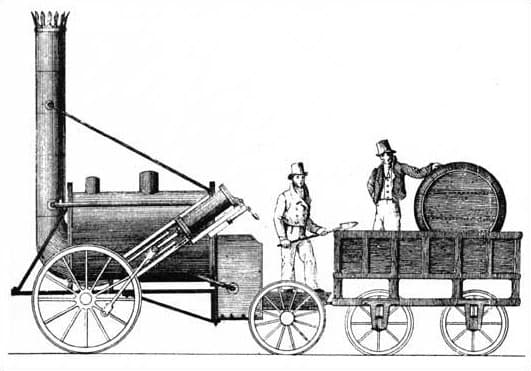
By the mid-1840s, the Bank of England had cut interest rates, and railway shares were booming. The rules were loose. Anyone could form a company and ask Parliament for a line, with no real check that it would pay. Many MPs were investors themselves. In 1846 alone, Parliament passed 263 railway Acts, for 9,500 miles of track. About a third was never built. George Hudson, the 'Railway King', paid his shareholders dividends out of their own capital.
9,500 mi
The turn had already come. In late 1845, the Bank of England raised rates again, and money flowed back into safe bonds. Railway shares stalled, then fell, and new investment stopped almost overnight. Many middle-class families lost their entire savings. But the track stayed. Schemes approved from 1844 to 1846 built 6,220 miles of railway, more than half the length of Britain's network today.
Quiz me
0/3
Recap
A genuinely successful railway (Liverpool and Manchester, 1830) convinced investors any railway would succeed; lax rules and self-interested MPs let that turn into a bubble that collapsed in 1845–1846.
Surprising fact · In 1846 alone, Parliament authorised 263 new railway companies and 9,500 miles of proposed track, about a third of which was never built.
Sources (3)
No source, no claim. Every fact in this lesson (14 claims) cites at least one of these.