How did a steam engine turn fire into motion?
A leaky coal mine, a wasted puff of steam, and a decades-old design flaw: fixing them gave Britain the engine that pumped, spun and hauled its way through a revolution.
▶ Start the storyA steam engine turns fire into motion. It boils water, then lets the steam's push — or the vacuum left when that steam condenses — drive a piston back and forth.
Its first job was water, not motion. English coal and tin mines kept flooding. Around 1712, an ironmonger named Thomas Newcomen built an 'atmospheric engine' to pump them dry. Steam filled a cylinder under a piston. A jet of cold water condensed it. The vacuum pulled the piston down, and a huge rocking beam hauled a pump chain up from the bottom of the mine.
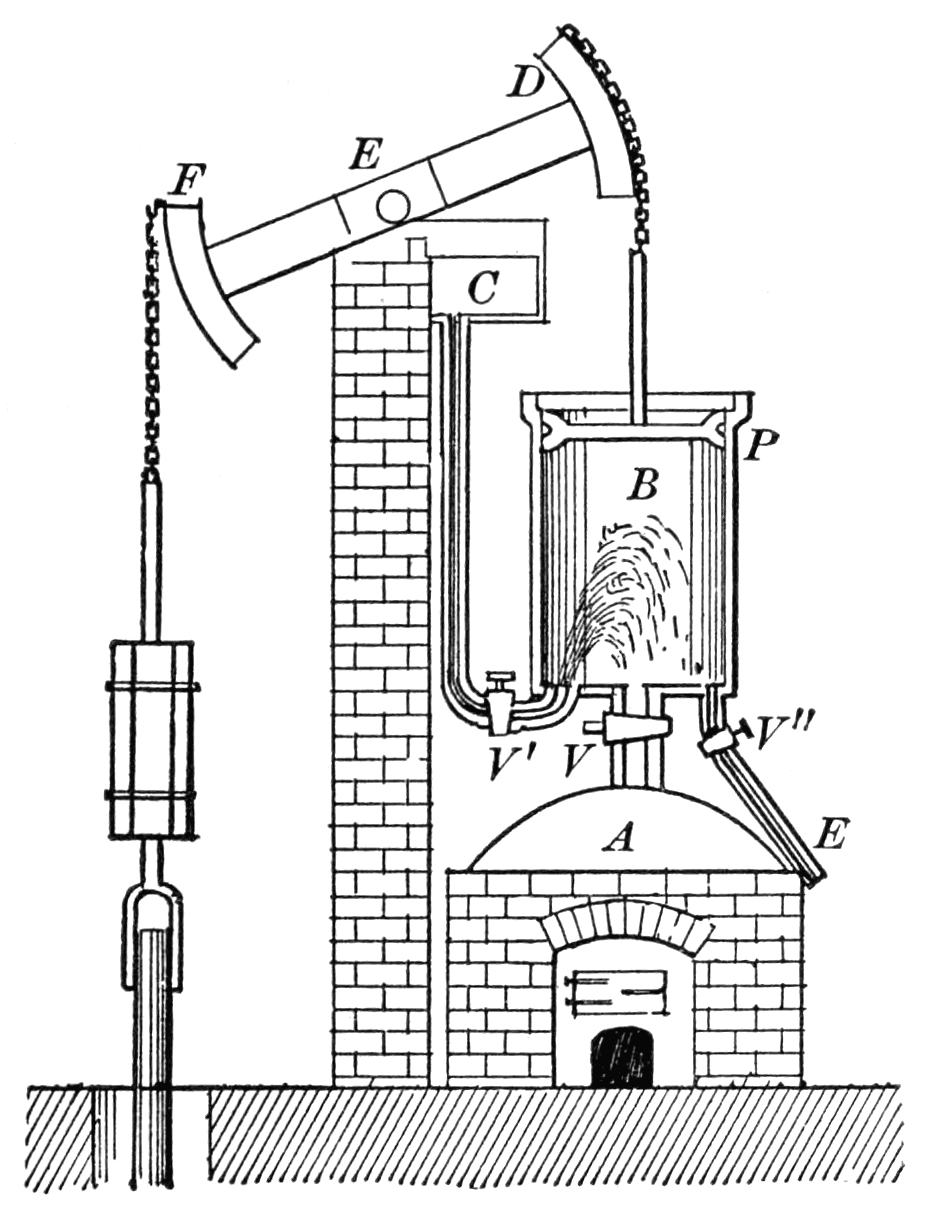
Step 1: Boil
A coal fire turns water into steam inside a boiler.
Step 2: Fill
Steam fills the cylinder, pushing up a piston.
Step 3: Condense
A jet of cold water condenses the steam, creating a vacuum.
Step 4: Pull
Air pressure shoves the piston down into the vacuum.
Step 5: Rock
A giant beam rocks on a fulcrum, driven by the piston.
Step 6: Pump
The beam's other end hauls a pump chain, draining the mine.
Newcomen's engine worked, but it wasted heat. Every stroke chilled the whole cylinder, which then had to be heated again from scratch. In May 1765, a Glasgow instrument maker named James Watt saw the fix while crossing Glasgow Green: condense the steam in a separate chamber, and keep the main cylinder hot. He patented the idea in 1769.
Watt spent years refining every part. His finished engine used half as much coal for the same power. Then he geared it to turn a shaft instead of just rocking a beam. A rotary engine could drive a mill's machines directly, so a factory no longer had to sit beside a river. Steam went on to drive the pumps, mills, ships and trains of the century that followed.
Quiz me
0/3
Recap
Newcomen's engine pumped mines by condensing steam; Watt's separate condenser kept the cylinder hot, and his finished engine needed half the coal.
Surprising fact · Watt's famous improvement wasn't a new invention but a fix for wasted heat in an engine already fifty years old.
Sources (4)
No source, no claim. Every fact in this lesson (16 claims) cites at least one of these.