How does seawater end up on a 1,000-year trip around the globe?
Wind drives the currents you see at the surface, but far below runs a loop set by temperature and salt, and its oldest water takes about 1,000 years to come back up.
▶ Start the storyIt sinks. Surface water flowing poleward from the equatorial Atlantic, as the Gulf Stream does, cools on the way and grows dense enough to sink, becoming part of the North Atlantic Deep Water. From there it spreads slowly through the deep ocean basins. Most of it rises again in the Southern Ocean, but the oldest water, after a transit of about 1,000 years, only upwells in the North Pacific.
This deep loop is called thermohaline circulation, from thermo- for temperature and haline for salt content, the two factors that together set seawater's density. Colder, saltier water is denser, and seawater keeps getting denser as it cools all the way to its freezing point, which can be below −2 °C. Wind and tides matter too: by mixing the ocean's layers, they make it possible for deep currents to exist at all.
Climate scientist Wallace Broecker coined the nickname "global conveyor belt" for it, and the water on that belt carries heat and dissolved gases around the planet, so its state greatly affects Earth's climate. Evidence suggests both of its major branches, one in the North Atlantic and one near Antarctica, are slowing as melting ice sheets dilute the water.
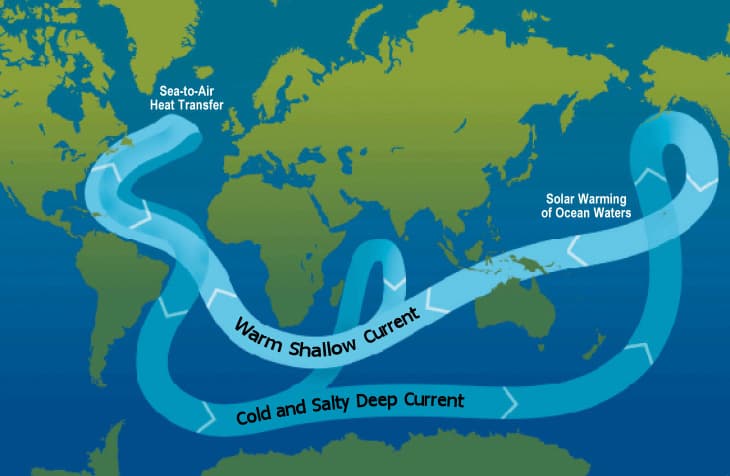
A full collapse of either branch would be a climate tipping point. If the Atlantic branch collapsed, many European countries would become substantially colder, while the east coast of North America would see faster sea level rise. Researchers generally think such a collapse is more than a century away and may only happen with rapid, high rises in sea temperature, but they stress that these projections are highly uncertain.
Quiz me
0/3
Recap
Cold, salty water is denser and sinks, feeding a deep current far slower than the wind-driven currents at the surface.
Surprising fact · The oldest water in this circulation takes about 1,000 years to complete a single loop before resurfacing in the North Pacific.
Sources (2)
No source, no claim. Every fact in this lesson (17 claims) cites at least one of these.