Was Monopoly invented to criticize landlords?
The world's most famous property-grabbing game began as a protest against landlords, and its inventor was paid $500.
▶ Start the storyYes. Monopoly grew out of The Landlord's Game, which Elizabeth "Lizzie" Magie patented in 1904 to show how rents enrich property owners and impoverish tenants. She was a follower of the economist Henry George, and her board was a lesson in disguise: by playing it, people would feel how unfair a world of land grabs could be.
Magie's game even came with two sets of rules. Under the monopolist rules you won by forming monopolies and forcing everyone else out, the version we still play. Under the anti-monopolist rules, later called Prosperity, everyone was rewarded when wealth was created, and the game ended when the poorest player had doubled their starting money. She hoped children would notice the injustice of the first version and remember it as adults.
The game spread hand to hand. College students drew their own boards, Quakers in Atlantic City renamed the streets after their town, and in 1932 a man named Charles Darrow learned it at a friend's dinner table. He then sold it himself as Monopoly, adding little more than symbols for the utilities and stations. Parker Brothers, who had once rejected Magie's game as too complicated, bought Monopoly from Darrow, who claimed to have invented it. In 1935 they paid Magie just $500 for her patent.
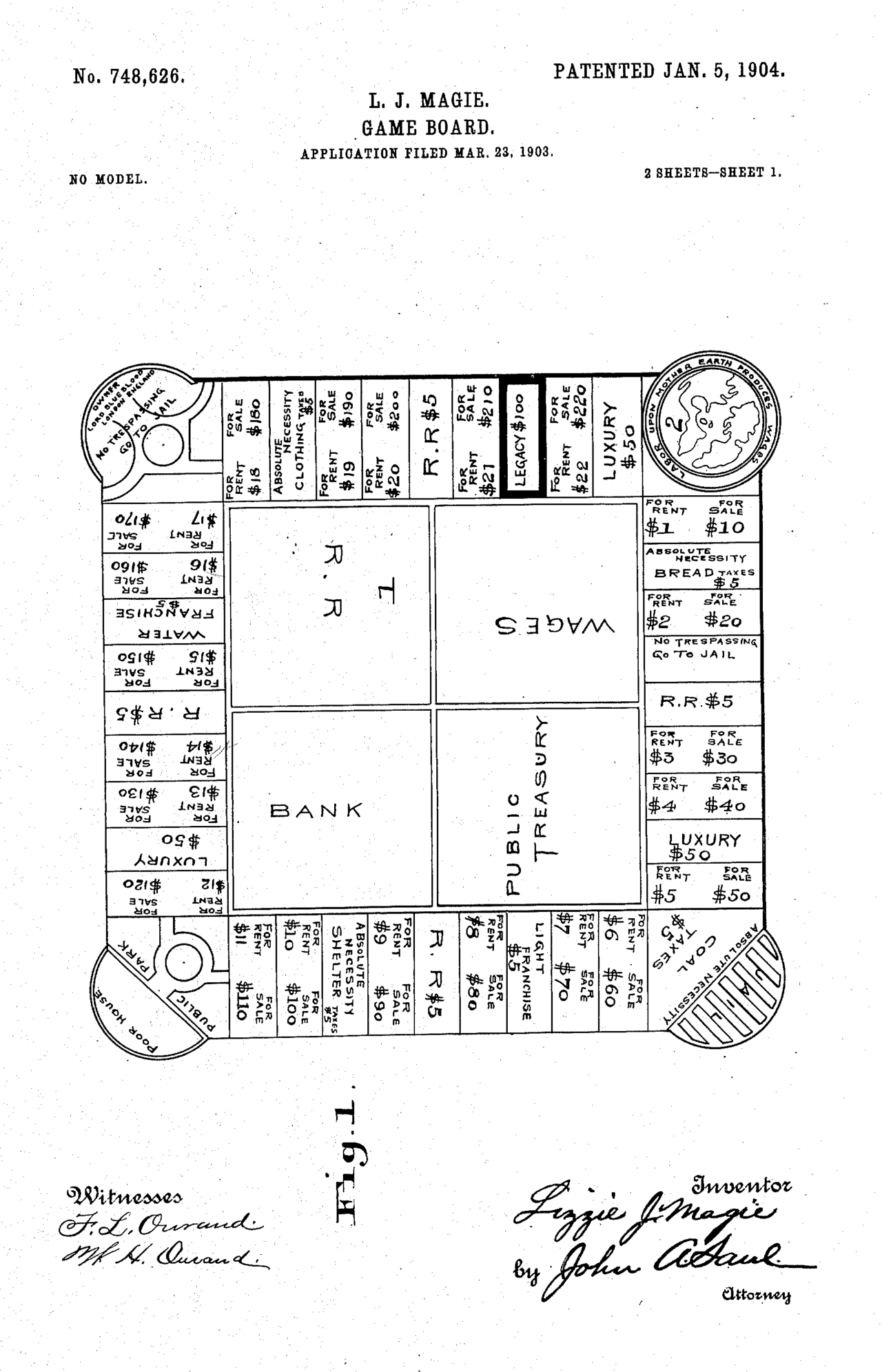
For decades Darrow got the credit. Only when Ralph Anspach, the creator of a game called Anti-Monopoly, dug up Magie's patents did her story come back to light.
1904
Magie patents The Landlord's Game
1909
Parker Brothers rejects it as too complicated
1932
Charles Darrow learns the game at a dinner
1935
Parker Brothers buys Magie's patent for $500
1973
Ralph Anspach publishes Anti-Monopoly and later uncovers Magie's patents
Quiz me
0/3
Recap
Monopoly was built to make you feel the unfairness of landlords, not to celebrate them.
Surprising fact · Parker Brothers once rejected Magie's game as too complicated, then paid her only $500 for the patent in 1935.
Connects to
- 🎲 What is the oldest board game in the world?
- Monopoly game
- Georgism
- Land value tax
Sources (3)
No source, no claim. Every fact in this lesson (17 claims) cites at least one of these.