What actually happened at the Battle of Marathon, before it became a race?
The runner who dashed from Marathon to Athens and died announcing victory is missing from Herodotus, the battle's main source. The real story is about terrain, tactics and two very different runs.
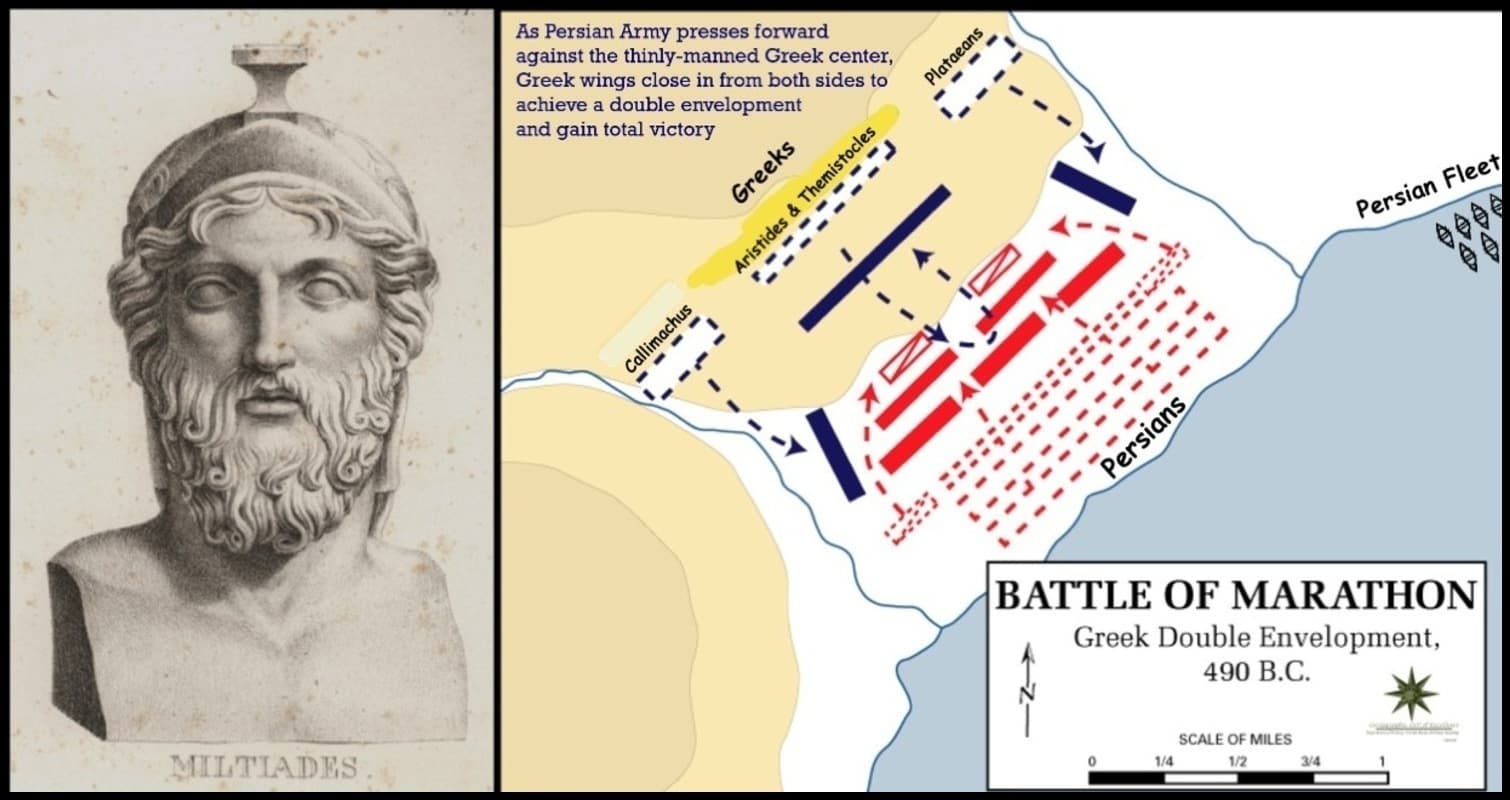
▶ Start the storyA Greek army beat a larger Persian one by using the ground as a weapon, and the famous dying messenger came much later. In 490 BC, during Persia's first attempt under King Darius I to subjugate Greece, the citizens of Athens, aided by Plataea, faced a Persian force commanded by Datis and Artaphernes. The Athenians and their allies chose a spot hemmed in by marshes and mountains, which kept the Persian cavalry from joining the infantry. Their general Miltiades reinforced his flanks and lured the best Persian fighters into his centre, then the flanks wheeled inward and enveloped them. The Persians broke in panic toward their ships, and the first Persian invasion of Greece was over.
Running mattered twice. Before the battle, Athens sent its greatest runner, Pheidippides, to ask Sparta for help: according to Herodotus, the main source for these wars, he covered more than 225 kilometres and arrived the day after he left, only to hear that Sparta could not march until the full moon rose. After the battle, the Athenian army marched about 40 kilometres back to Athens at a very high pace to head off the Persian fleet sailing around Cape Sounion, and arrived in time to see the ships turn away.
Popular imagination later merged those two events into one legend: Pheidippides running from Marathon to Athens, announcing "we've won!" and dropping dead. That story first appears in Plutarch, in the 1st century AD, who gives the runner's name as most likely Eucles; in the 2nd century Lucian calls him Philippides. In 1896, Michel Bréal's idea of a "marathon race" for the first modern Olympics in Athens deliberately echoed that legend.
Quiz me
0/3
Recap
The real history involves two different runs, Pheidippides to Sparta before the battle and the army's forced march back to Athens after it; later storytellers merged them into the single legendary run that gave the marathon its name.
Surprising fact · The famous story of a messenger running from the battlefield to Athens and dying after shouting 'we've won' first appears in writing in Plutarch, in the 1st century AD, centuries after the battle.
Sources (1)
No source, no claim. Every fact in this lesson (12 claims) cites at least one of these.