Why is a marathon exactly 42.195 km?
The odd 195 metres have nothing to do with ancient Greece and everything to do with a stadium door in London.
▶ Start the storyA marathon is 42.195 kilometres because of the 1908 Olympic Games in London, not because of ancient Greece. The London organisers planned about 26 miles from Windsor Castle to the Olympic stadium, and the runners finished with 385 yards inside the stadium, in front of the Royal Box. In 1921 the international athletics federation, the IAAF, took the length used in London and made it the standard: 42.195 km.
The Greek story still matters. The race was dreamed up by the French philologist Michel Bréal for the first modern Olympics, in Athens in 1896. It was inspired by the legend of Pheidippides, a messenger said to have run from the battlefield of Marathon to Athens without stopping, announced the victory and dropped dead. Early Olympic marathons were about 40 kilometres, roughly the road from Marathon to Athens, and the exact length depended on each city's course.
London's strange number came from royal logistics. With the king's permission, the start was put on the private lawn of Windsor Castle to keep the crowds away. The plan was to enter the stadium through the Royal Entrance and run a full lap to the finish line in front of the Royal Box. Shortly before the Games, the organisers realised that entrance could not be used, so the runners came in through another one and the stretch inside the stadium shrank to 385 yards.
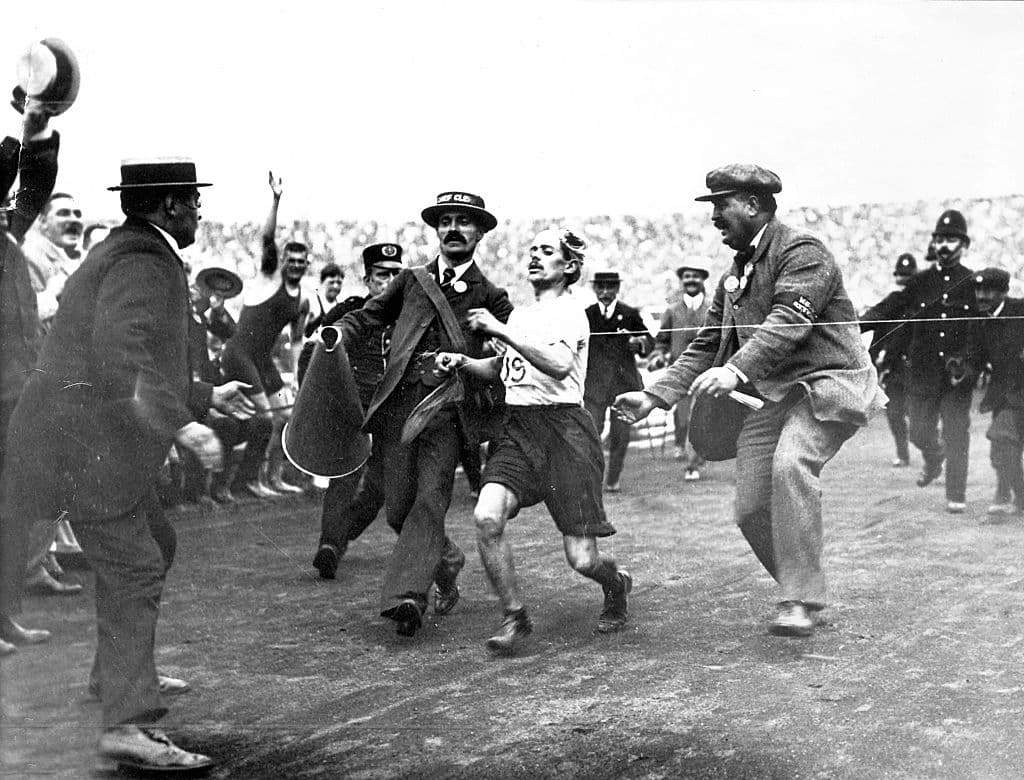
That same race gave sport one of its most famous finishes. The Italian Dorando Pietri reached the stadium first but collapsed, falling five times and being helped up by officials in front of 75,000 spectators. He crossed the line first and was then disqualified for the help he received. The American Johnny Hayes was declared the winner.
26 mi + 385 yd
Quiz me
0/3
Recap
Greece gave the marathon its name, but London gave it its length.
Surprising fact · Early Olympic marathons were only about 40 km, and Boston ran 24.5 miles until 1924.
Connects to
- 🛡️ What actually happened at the Battle of Marathon, before it became a race?
- 🧱 Why do marathon runners suddenly hit the wall?
- Pheidippides
- 1908 summer olympics
Sources (3)
No source, no claim. Every fact in this lesson (16 claims) cites at least one of these.