What makes something sublime instead of just beautiful?
A flower is beautiful. A storm that could kill you is something else entirely. Philosophers have long argued over what makes that second feeling different.
▶ Start the storyIts overwhelming greatness. In aesthetics, the sublime is the quality of greatness, physical, moral, spiritual or artistic, and especially a greatness beyond all possibility of calculation, measurement or imitation. Beauty can be taken in; the sublime can't, and from the late 17th century on, writers described it as pleasure mixed with something close to horror. The first known study of it comes from Longinus, for whom the sublime was great, lofty thought or language, especially in rhetoric, inspiring awe and making an argument more persuasive.
The idea took on a harder edge once writers started crossing the Alps. John Dennis described the journey as a pleasure to the eye, like music to the ear, but mingled with horror and almost despair, and Joseph Addison wrote that the Alps fill the mind with an agreeable kind of horror. Edmund Burke turned that contradiction into philosophy: he was the first to argue that sublimity and beauty are mutually exclusive, as opposed to each other as light and darkness, and he described the sublime's specific pleasure as a kind of negative pain he called 'delight', distinct from ordinary positive pleasure.
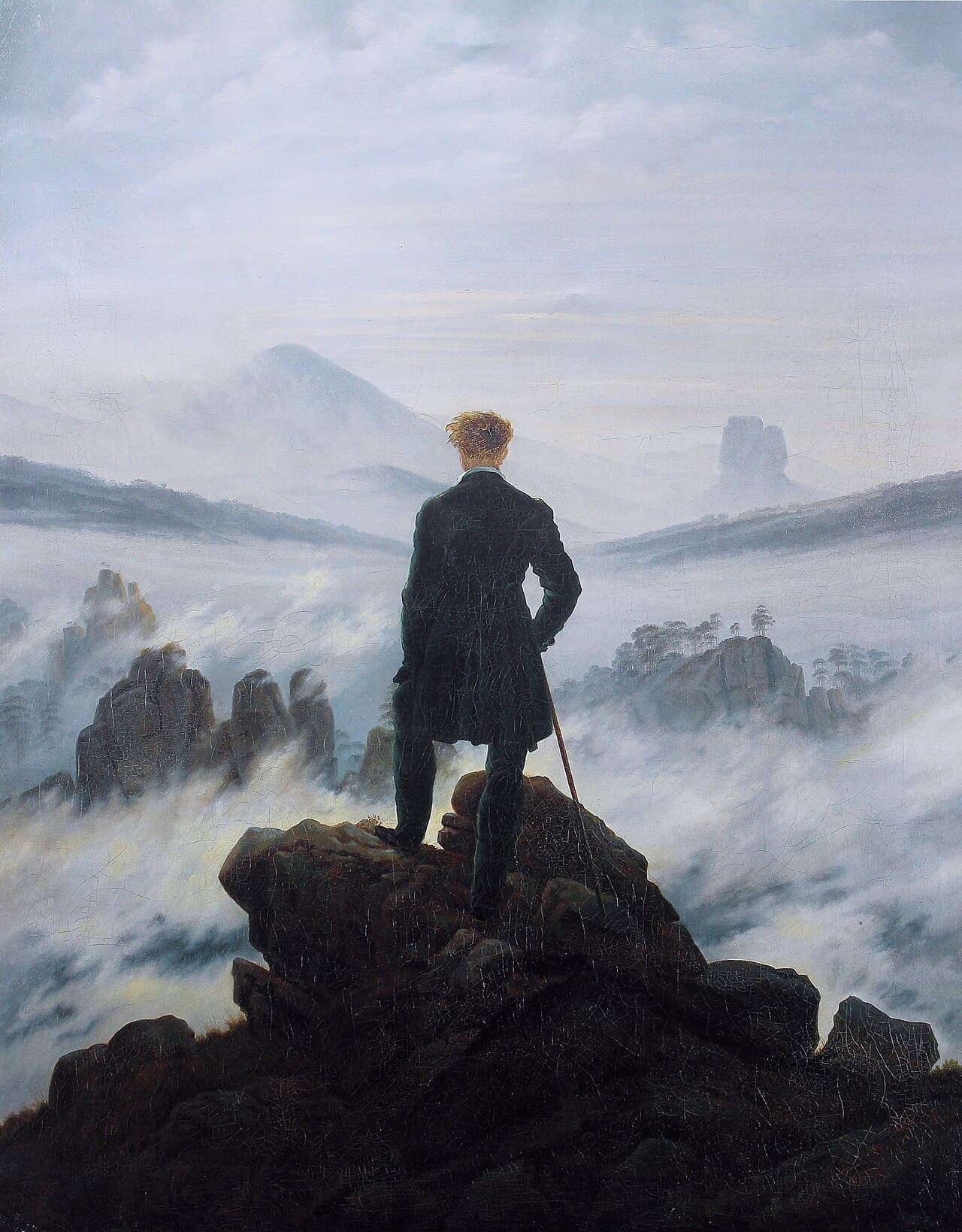
Immanuel Kant drew the line even more sharply. Beauty, he said, is connected with the form of an object and has boundaries; the sublime is found in a formless object, represented instead by boundlessness. Beauty belongs to the Understanding, while the sublime belongs to Reason, showing a mental faculty that surpasses every standard of the senses. Arthur Schopenhauer put it in terms of danger: beauty invites you to lose yourself quietly in an object, while the sublime confronts you with something overpowering and vast enough that it could destroy you.
John Ruskin later turned the whole debate toward the moral and spiritual, arguing that truly seeing nature's grandeur meant perceiving the divine order beneath it, not just feeling a thrill of fear.
Quiz me
0/3
Recap
Burke, Kant and Schopenhauer each separated the sublime from the beautiful, tying the sublime to vastness, boundlessness or danger.
Surprising fact · Kant argued the sublime is found in formless, boundless objects that defeat the senses, while beauty is tied to an object's bounded form.
Sources (1)
No source, no claim. Every fact in this lesson (20 claims) cites at least one of these.