Why did Adam Smith think a country should only make what it does best?
Long before trade theory got its modern refinements, Adam Smith had a simple rule for nations: make what you're most efficient at, and buy the rest.
▶ Start the storyAdam Smith's answer was: because trying to make everything yourself wastes effort. In The Wealth of Nations, published in 1776, Smith argued that if one country can produce a good using less labour than another country needs for the same good, that country has an absolute advantage in it, and should specialize in making it rather than everyone trying to do everything.
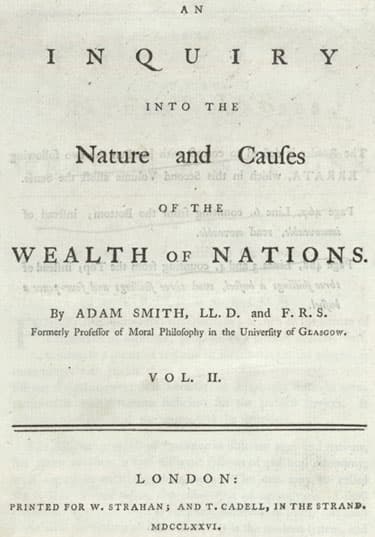
Smith was arguing against mercantilism, the dominant economic doctrine of his time, which tried to grow a nation's wealth through state-controlled monopolies, tariffs and trade restrictions, measuring success in gold piled up in the treasury. Smith said this missed the point: a nation's real wealth is the goods and services its people actually have, not the metal in its vaults. Under mercantilism, one country's gain always looked like another's loss. Smith rejected that zero-sum view: free exchange and specialization, he argued, let everyone end up with more.
His logic is easiest to see with two countries and two goods. Imagine the UK needs 80 hours of labour to make a unit of cloth, fewer than Portugal needs for the same cloth, while Portugal needs only 90 hours to make a unit of wine, fewer than the UK needs. The UK has the absolute advantage in cloth, Portugal in wine. If each puts its labour into the good it makes most efficiently and they trade the surplus, the pair goes from 2 units of cloth and 2 of wine to 2.25 units of cloth and about 2.33 of wine, so both can end up with more of each than if each had tried to produce everything at home.
There was a gap in the idea, though: because Smith only compared raw labour efficiency, his rule says nothing about what a country should do if it has no absolute advantage in anything. David Ricardo later built a sharper idea, comparative advantage, partly on Smith's critique of mercantilism.
Quiz me
0/3
Recap
If a country can produce a good with less labour than another country needs, specializing in that good and trading for the rest leaves both countries with more overall.
Surprising fact · Because it only compares labour productivity, a country can have no absolute advantage in anything, a gap later addressed by comparative advantage.
Sources (2)
No source, no claim. Every fact in this lesson (17 claims) cites at least one of these.