Why did cotton spinning move out of cottages and into Britain's first factories?
A spinner feeding eight threads at once with one wheel, a mob smashing his machines, and a wig-maker who turned thread into a 13-hour shift bell: that's how cotton became Britain's first factory industry.
▶ Start the storyCotton spinning left the cottage because the best new spinning machine was too big, and too hungry for power, to run at home. Once spinning needed a water wheel, it needed a factory.
The squeeze started at the loom. In 1733, John Kay's flying shuttle doubled how fast a weaver could work. Home spinners could no longer make thread fast enough. Around 1764, James Hargreaves, a weaver near Blackburn, built the spinning jenny. One wheel turned many spindles, so one spinner could work eight threads at once. Yarn prices fell. Angry local spinners broke into his house and smashed his machines, and in 1768 he fled to Nottingham.
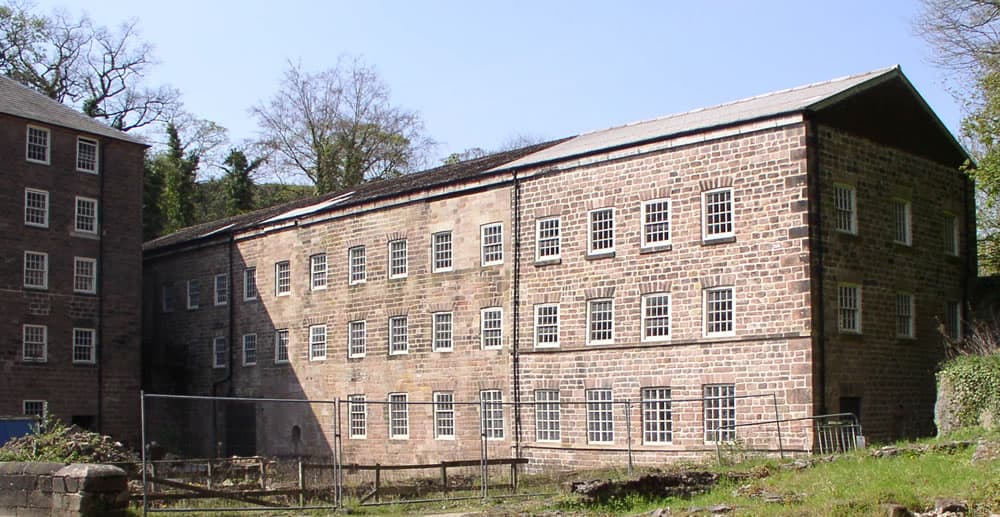
The jenny still fit in a cottage, but its thread was weak. It couldn't serve as warp, the strong lengthwise threads of cloth. Richard Arkwright, a former barber and wig-maker, fixed that. In 1769 he patented the water frame, which twisted thread between rollers instead of fingers. It needed real power: first horses, then water. In 1771, Arkwright and his partners opened a water-powered mill at Cromford, in Derbyshire. It is often called the world's first true factory.
Hargreaves's spinning jenny (1764–1765)
- Turned by hand, worked in a cottage
- One spinner ran 8+ spindles at once
- Thread too weak for warp threads
- Cheap, spread fast among home spinners
Arkwright's water frame (1769)
- Needed horse or water power, not hand strength
- Twisted thread between rollers, little training needed
- Produced strong warp-quality yarn
- Powered the first true factory, at Cromford
Cromford put carding and spinning under one roof and employed 200 people from the start. The village was too small, so Arkwright brought in workers and built cottages for them. Work ran in two 13-hour shifts. A bell rang at 5, and the gates shut at 6 sharp. Latecomers lost the whole day, plus an extra day's pay. No cottage spinning wheel had ever kept that kind of clock.
Quiz me
0/3
Recap
The jenny let one spinner work many threads by hand; Arkwright's water frame made stronger thread but needed water power and a factory to run it.
Surprising fact · A mob destroyed the spinning jenny inventor's own machines and drove him out of town, because his jennies were pushing down the price of yarn.
Sources (2)
No source, no claim. Every fact in this lesson (15 claims) cites at least one of these.