Why do giant boulders of the wrong rock sit alone in flat fields?
A 16,500-tonne rock sits on the Alberta prairie, the biggest stone in a 600-kilometre trail of boulders that ice left behind.
▶ Start the storyBoulders that don't match the rock around them sit out in fields and plains because glaciers carried them there, sometimes hundreds of kilometres from where they broke off. Geologists call them glacial erratics, from the Latin word for 'to wander', and they range from pebbles to monsters like Big Rock in Alberta, which weighs about 16,500 metric tons.
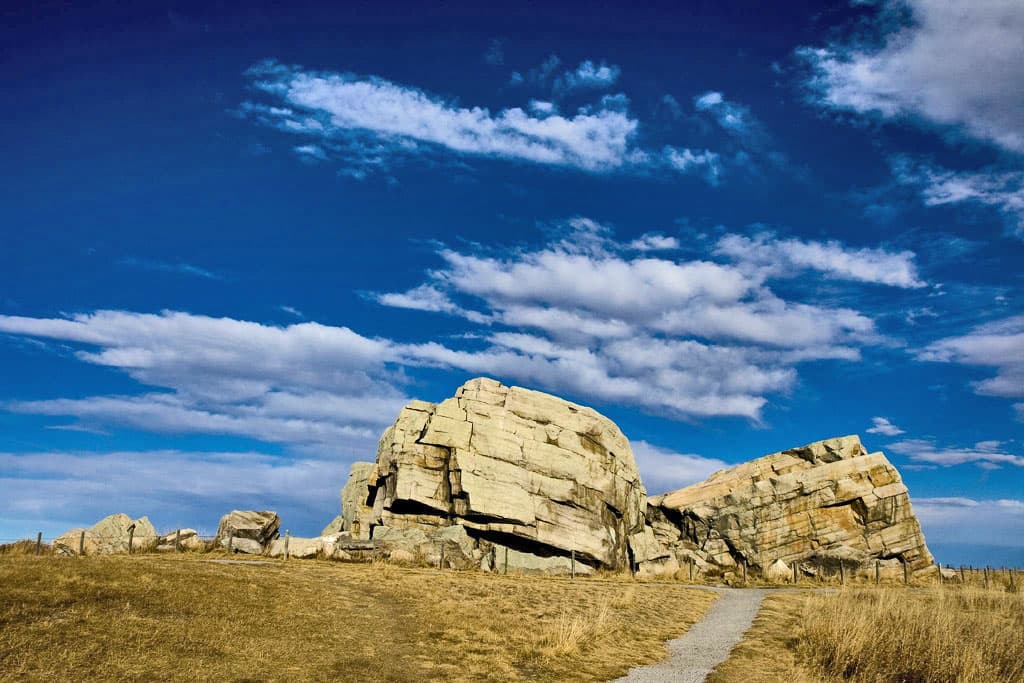
Ice usually picks up these rocks in one of two ways. Moving ice can scrape and pluck pieces directly off the bedrock it grinds over, or a glacier can undercut a cliff until the rock face avalanches onto the ice's surface and rides along on top. Either way, when the ice finally melts, whatever boulder it was carrying is left behind, often sitting on a completely different kind of rock than itself.
For a long time, these boulders were a puzzle. In the 18th century, erratics were deemed a major geological paradox, and they were once taken as evidence of a biblical flood. As early as 1788, the Swiss jurist and theologian Bernhard Friedrich Kuhn saw glaciers as a possible solution, and in the 19th century many scientists came to see erratics as evidence that an ice age had ended around 10,000 years ago. Louis Agassiz was the first to scientifically argue that the Earth had gone through a past ice age, building on earlier naturalists who had concluded that alpine boulders scattered across the Jura Mountains had been moved there by glaciers. Charles Darwin saw huge erratics south of the Strait of Magellan on the voyage of the Beagle and attributed them to ice rafting from Antarctica; more recent research suggests glacial ice flows carried them instead.
Some erratics became landmarks in their own right. Plymouth Rock, where the Mayflower Pilgrims landed in 1620, is a glacial erratic. In Fitchburg, Massachusetts, workers moved a 110-ton erratic called the Rollstone Boulder to a downtown park in 1929 and 1930 to save it from quarrying.
Quiz me
0/3
Recap
If a boulder's rock doesn't match the ground it sits on, it may be an erratic: geologists compare it with the surrounding rock and trace it back to its parent bedrock.
Surprising fact · Plymouth Rock and Alberta's 16,500-tonne Big Rock are both glacial erratics.
Sources (1)
No source, no claim. Every fact in this lesson (20 claims) cites at least one of these.