Why can't anyone agree on how long Norway's coastline actually is?
Include its fjords and Norway's coast stretches 29,000 kilometres; leave them out and it shrinks to barely 2,500, a more than tenfold difference carved by ancient glaciers.
▶ Start the storyAsk how long Norway's coastline is and you'll get wildly different answers depending on whether you count its fjords. Including them, the coast stretches an estimated 29,000 kilometres; leave the nearly 1,200 fjords out, and the same coastline shrinks to just 2,500 kilometres — more than a tenfold difference, and one of the most extreme examples anywhere of the famous "coastline paradox," where a coast's measured length depends heavily on how closely you trace its wiggles.
The reason fjords add so much length is how they're built. A fjord forms when a glacier carves a deep, U-shaped valley into the bedrock, grinding the rock away by abrasion as it moves. Once the glacier retreats and the ocean floods in, that long, narrow, steep-walled valley becomes a fjord — the glacial cousin of a drowned river valley. Most fjords end up deeper than the sea right outside their mouth; Norway's Sognefjord, nicknamed the "king of fjords," plunges as much as 1,300 metres below sea level while stretching 204 kilometres inland.
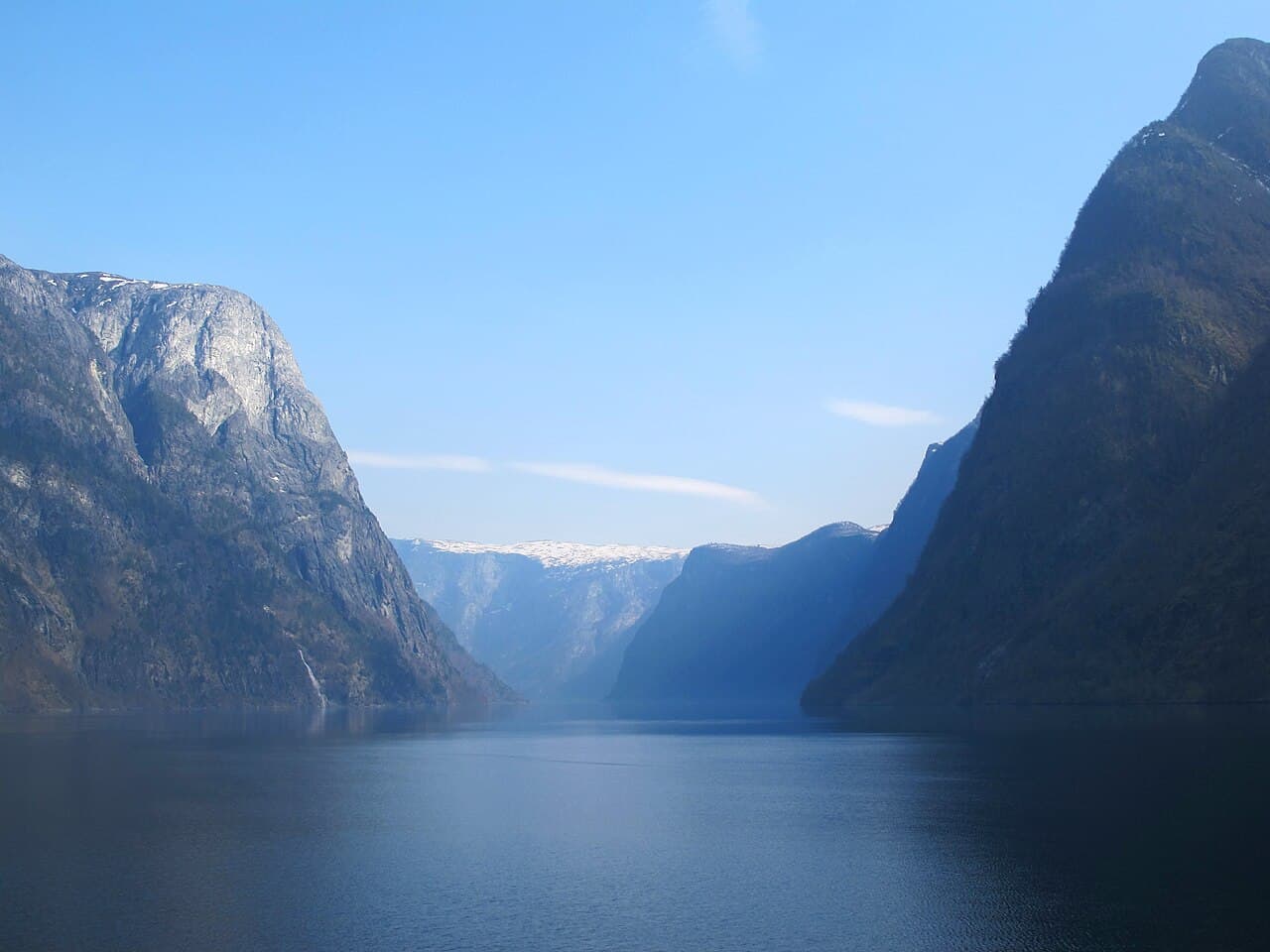
At the mouth of many fjords sits a raised lip of rock called a sill, left behind because the glacier eroded less forcefully there, near its thinning edge, than it did farther inland. That sill can squeeze tides into ferociously fast currents: Saltstraumen in Norway is often described as the strongest tidal current on Earth. Inside the fjord, the water itself often comes in two distinct layers, since fresh water from rivers floats on top of denser salt water and the two barely mix.
It took a surprisingly long argument to settle how fjords actually form. In the 19th century, Jens Esmark proposed that glaciers had carved them, and that vast stretches of Northern Europe had once been buried under thick ice. Another scientist, John Walter Gregory, argued instead that fjords were shaped by tectonic forces with glaciers playing almost no role — a theory later research firmly rejected in favor of Esmark's glacial explanation.
Quiz me
0/3
Recap
Sognefjord, Norway's longest and deepest fjord, plunges 1,300 metres below sea level, deeper than the open sea just outside it.
Surprising fact · Counting Norway's fjords makes its coastline over ten times longer than if they were excluded.
Sources (2)
No source, no claim. Every fact in this lesson (12 claims) cites at least one of these.