Why are cattle sacred in some religions and sacrificed in others?
A belief that rifle cartridges were greased with cow and pig fat played a role in an 1857 rebellion in India.
▶ Start the storyCattle carry heavy religious meaning in many traditions, but which meaning depends on each tradition's starting principles. In Hinduism, Jainism and Buddhism, cattle are considered sacred, and the respect rests on ahimsa, non-violence toward all beings; laws against slaughtering cattle are in place in most Indian states. In the Hebrew Bible and in Islam, cattle instead appear as ritual sacrifices or as food allowed under strict slaughter rules, and worshipping a golden calf is condemned as a grave offense against God. Same animal, very different first principles.
In Hinduism, ahimsa is already mentioned in the Chandogya Upanishad, around 800 BCE. The Rigveda calls dairy cows "aghnya", that which may not be slaughtered, and Hindu mythology tells of Kamadhenu, the miraculous "cow of plenty" seen as the source of all prosperity. Several scholars add an economic explanation: dairy, dung for fuel and fertilizer, and the work cattle did in the fields.
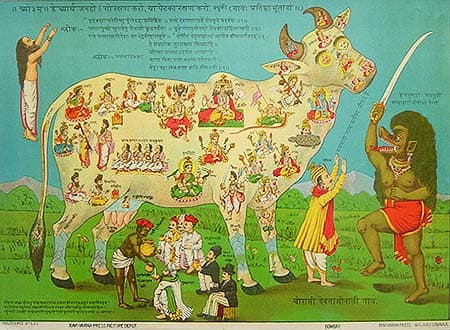
That reverence had political weight. In 1857, Hindu and Muslim sepoys in the East India Company's armies came to believe that their paper cartridges were greased with cow and pig fat, and loading the gun meant biting the cartridge open. Pork is forbidden in Islam, the cow is revered in Hinduism, and the soldiers concluded the Company was forcing them to break their religion's rules. They mutinied, and cow reverence played a role in the Indian Rebellion of 1857. Later, Mahatma Gandhi made cow protection a symbol of non-violence toward all life: "I worship it and I shall defend its worship against the whole world."
Jainism and Buddhism reach respect for cattle from their own principles: Jaina sutras teach that all living beings are fond of life and long to live, and Buddhism counts refraining from killing living beings among its five precepts. Elsewhere, the Hebrew Bible describes an unblemished red cow burned so its ashes could purify people who had touched a corpse, Islam names its longest surah "The Cow", and Zoroastrianism reads the cow's spirit, geush urva, as the soul of the Earth.
Quiz me
0/3
Recap
Whether cattle are protected or sacrificed depends on each tradition's first principles, such as ahimsa in the Indian religions.
Surprising fact · In the 19th century, Indian poster art showed Kamadhenu, the cow of plenty, with all the major Hindu gods and goddesses inside her.
Sources (1)
No source, no claim. Every fact in this lesson (21 claims) cites at least one of these.