Why did Columbus call the people he met "Indians" — and what followed?
He believed he had reached Asia, and he never clearly gave up that belief. For the people who already lived there, what followed was catastrophic.
▶ Start the storyChristopher Columbus called the people he met in the Caribbean indios, 'Indians', because he believed he had sailed west and reached the East Indies, the islands of Asia he was seeking as a shortcut to the spice trade. How far he ever understood that the Americas were a separate landmass is uncertain: across four voyages, he never clearly renounced his belief that he had reached the Far East.
The voyage itself only happened because the Catholic Monarchs of Spain, Isabella and Ferdinand, agreed after years of lobbying to fund Columbus's gamble. He left Spain in August 1492 and made landfall on 12 October on a Bahamian island its inhabitants called Guanahani, meeting the Lucayan, Taíno and Arawak peoples. In his journal that same day, he wrote of the people he met that they would make 'good and intelligent servants' and would 'become Christians very easily,' since it seemed to him they had no religion of their own.
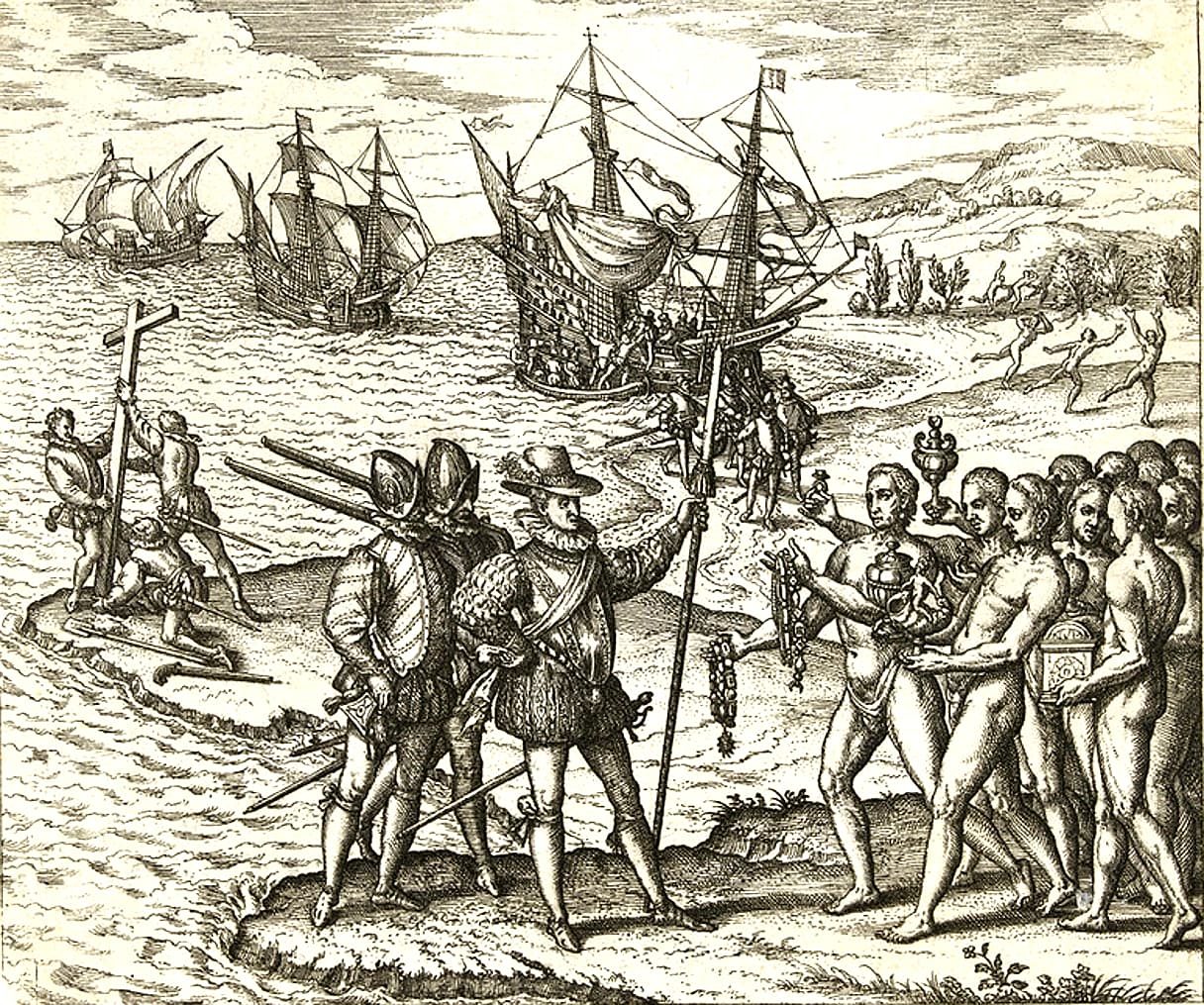
What followed is known as the Columbian exchange: a vast transfer of plants, animals, precious metals, people, technologies and diseases between the Old World and the New. For the Indigenous peoples of Hispaniola, where Columbus governed, it was catastrophic. They were enslaved and mistreated by his government, Columbus waged war on the island's Taíno until they surrendered and paid tribute, and diseases from the Old World spread among them. A third of the Native people forced to work in the gold and silver mines died every six months, and within three to six decades the surviving Arawak population numbered only in the hundreds. Across the Americas, one estimate puts the decline of the Indigenous population at about 90 percent within a century. Columbus himself was accused by contemporaries of significant brutality and removed from his post. Historians disagree on the word for it: Kris Lane disputes calling it genocide when the atrocities resulted from Columbus's decrees, family business goals and negligence rather than his intent, while Samuel Eliot Morison wrote that the cruel policy Columbus began "resulted in complete genocide."
Quiz me
0/3
Recap
Historians disagree on whether to call the devastation of Hispaniola's Indigenous peoples a product of disease, of deliberate violence, or of both together.
Surprising fact · One estimate puts the decline of the Americas' Indigenous population at about 90 percent within a century of Columbus's arrival.
Sources (1)
No source, no claim. Every fact in this lesson (22 claims) cites at least one of these.