Why did a murdered Roman's old letters help spark the Renaissance?
He was executed for the speeches he wrote against Mark Antony. About fourteen centuries later, the rediscovery of his letters helped spark the Renaissance.
▶ Start the storyHistorians credit the Renaissance partly to a Roman politician's old mail, because when the poet Petrarch rediscovered a cache of Cicero's letters in the fourteenth century, it reignited interest in classical culture across Europe; one historian went so far as to call the Renaissance "above all things a revival of Cicero." His standing as a writer helps explain why: Cicero is considered one of Rome's greatest orators and prose stylists, and his letters reached readers long after a violent death.
Marcus Tullius Cicero was the innovator of what became known as "Ciceronian rhetoric." He carried an unglamorous hereditary nickname: cicer is Latin for chickpea, supposedly given to an ancestor with a chickpea-shaped cleft on his nose. He was urged to drop it when he entered politics, but Cicero refused, vowing he'd make Cicero more glorious than rivals nicknamed "Swollen-ankled" and "Puppy." He also reshaped the Latin language itself, adapting Greek philosophy into Latin and coining nearly 150 new philosophical terms in the process.
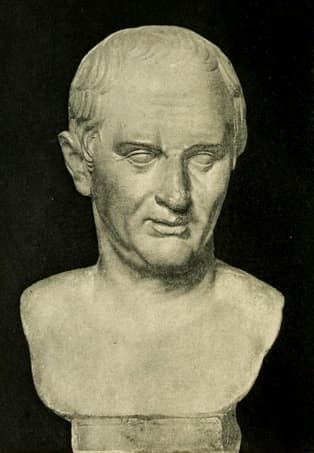
His politics were just as consequential, and far more dangerous. As consul in 63 BC he crushed the Catilinarian conspiracy, earning the honorific "father of the fatherland", but his decision to execute five conspirators without trial triggered his own exile five years later. After Julius Caesar's assassination, Cicero turned his pen against Mark Antony, attacking him in a series of speeches he called the Philippics. It cost him everything: when Antony and Octavian joined forces in the Second Triumvirate, Cicero was proscribed, and when soldiers caught him trying to escape Italy in 43 BC, Cicero bowed his head from his litter, baring his throat rather than resisting. On Antony's orders, his hands, the hands that had written the Philippics, were cut off along with his head and nailed to the Rostra, the speaker's platform in the Roman Forum. He was the only victim of that purge displayed in such a way.
And yet his words outlasted his executioners by millennia. Centuries after Petrarch's rediscovery, Cicero's influence peaked again during the Enlightenment, shaping thinkers like John Locke, David Hume, Montesquieu and Edmund Burke. His book De Officiis was the second work ever printed in Europe, right after the Gutenberg Bible.
Quiz me
0/3
Recap
A politician's writing can outlast the regime that kills him: Cicero's rediscovered letters helped spark the Renaissance fourteen centuries after his execution.
Surprising fact · After Gutenberg invented the printing press, Cicero's De Officiis was the second book printed in Europe, after the Gutenberg Bible.
Sources (1)
No source, no claim. Every fact in this lesson (14 claims) cites at least one of these.