Why do we have seasons, and why does Uranus seem to spin on its side?
A Greek explorer measured Earth's tilt with a stick's shadow around 350 BCE, and Uranus, probably knocked over by a collision billions of years ago, gives each pole about 42 years of sunlight followed by 42 years of darkness.
▶ Start the storyEarth doesn't spin perfectly upright relative to its path around the Sun; its axis leans by about 23.44 degrees, an angle astronomers call axial tilt or obliquity. Because that tilt stays pointed in the same direction throughout the year, one hemisphere leans toward the Sun for half the orbit and away from it for the other half. That single, simple fact is the cause of Earth's seasons: when the North Pole leans toward the Sun, it's summer up north, and when it leans away, it's winter.
People have been measuring this angle for a very long time. Around 350 BCE, the Greek explorer Pytheas of Marseilles worked it out using nothing more than the shadow cast by a stick, a gnomon, at the summer solstice. Centuries later, around 830 CE, the Caliph Al-Mamun of Baghdad had his astronomers measure it again, and in 1437 the astronomer Ulugh Beg pinned it down to 23°30′17″ (23.5047°), close to today's 23.44. The first accurate modern Western measurement came from Tycho Brahe in Denmark around 1584.
Earth's gentle 23-degree lean gives us mild seasons. Uranus shows what happens when a planet's tilt goes to extremes: its axis is tipped by about 82 degrees, meaning it essentially rolls around the Sun on its side rather than spinning upright. Near its solstices, one of its poles points almost directly at the Sun continuously while the other faces away in darkness, with only a thin strip near the equator getting anything like a normal day-night cycle.
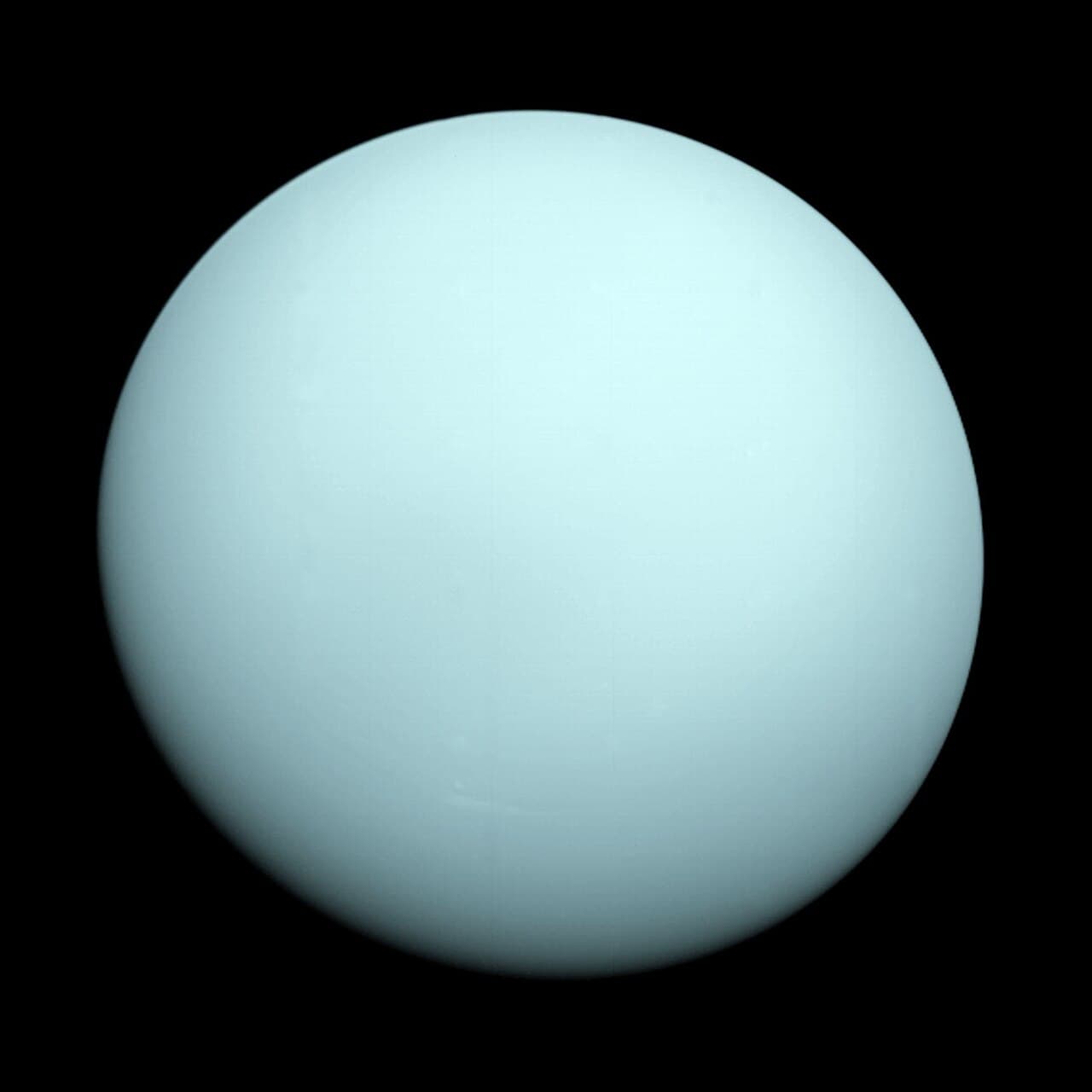
Nobody knows for certain why Uranus ended up this way, but the leading idea is a truly enormous collision: sometime billions of years ago, an object roughly the size of Earth or larger is thought to have slammed into the young planet and knocked its spin axis sideways. When NASA's Voyager 2 flew past Uranus in 1986, the planet's south pole happened to be pointed almost directly at the Sun — a snapshot of just how strange Uranus's seasons really are, all because of one number: the angle of its tilt.
Quiz me
0/3
Recap
Summer happens in whichever hemisphere is currently tilted toward the Sun.
Surprising fact · Uranus is tilted about 82 degrees, probably from an ancient collision, so each pole gets around 42 years of sunlight, then 42 years of darkness.
Sources (3)
No source, no claim. Every fact in this lesson (18 claims) cites at least one of these.