Was "an eye for an eye" actually meant to stop revenge?
The most famous line of Hammurabi's 3,700-year-old law code wasn't a call for vengeance. It was a ceiling on it.
▶ Start the story"An eye for an eye" sounds like a license for revenge, but in Hammurabi's Babylon it worked more like a speed limit. In a world without courts you could trust, a person who was hurt, or their family, might strike back far harder than the original injury, even killing the offender. Babylonian law capped that: the payback could be no worse than the crime. The idea, as later readers put it, was to keep compensation to the value of the loss and to stop blood feuds from spiralling.
The Code of Hammurabi, written around 1753 BC, is the longest and best-preserved legal text of the ancient Near East. Its main copy is a basalt stone 2.25 metres tall, now in the Louvre. Its laws read like a rulebook of cases: if this happens, then that follows. Laws 196 and 200 give an eye for an eye and a tooth for a tooth.
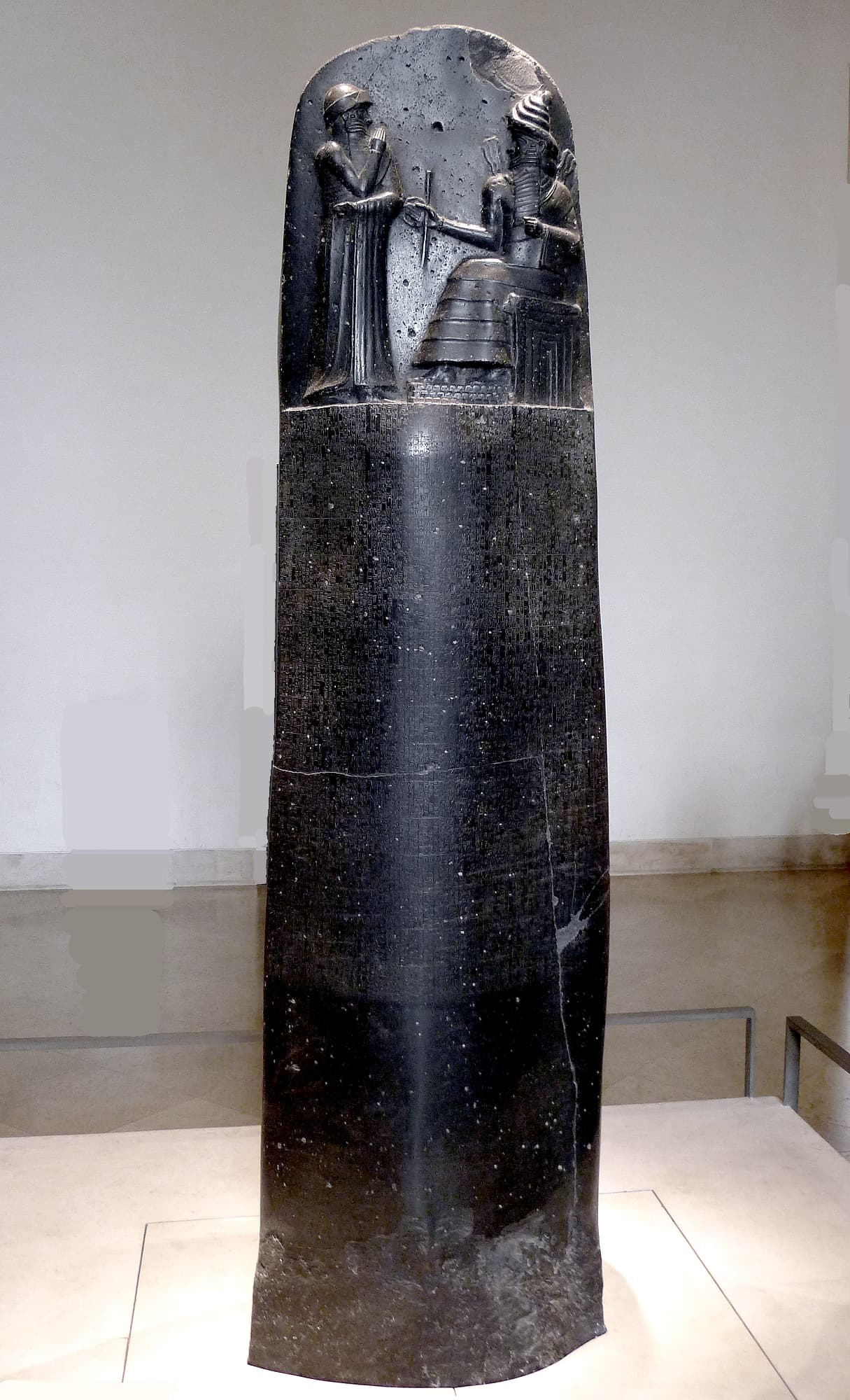
It was not a gentle code by our standards. People were not equal before it: a gentleman, a commoner and a slave got different treatment, and the limit on revenge only held between people of the same status. Punishment could even fall on a wrongdoer's children: if a badly built house killed the owner's son, the builder's son was to die.
Still, there is something touching in it. Hammurabi says the gods made him king to stop the strong from oppressing the weak, and he hoped that any wronged man could have the stone read aloud to him and learn his rights. Carving the rules in public, where anyone could point at them, was a step toward law that binds everyone, not just the whims of the powerful.
Quiz me
0/3
Recap
"An eye for an eye" meant "no more than an eye": a limit on vengeance, not a license for it.
Surprising fact · The stele was carried off as war plunder to Susa and only rediscovered by archaeologists in 1901.
Sources (2)
No source, no claim. Every fact in this lesson (20 claims) cites at least one of these.